Contents
- What Are AI Agents?
- Why Tennis Is Perfect for AI Agents
- The New Generation of Tennis Applications
- AI Agents Never Stop Working
- Tennis Prediction Agents
- Betting Agents Are Driving API Growth
- Automated Tennis Content Creation
- Tennis Coaching and Performance Agents
- Personalized Tennis Assistants
- Why Historical Data Matters
- The Rise of Multi-Agent Tennis Systems
- What Happens Next?
- Final Thoughts
Artificial intelligence has already transformed how tennis fans consume information, how analysts evaluate players, and how betting companies generate predictions. However, a new wave of technology is now emerging that could have an even bigger impact on the tennis industry than traditional AI models.
That technology is AI agents.
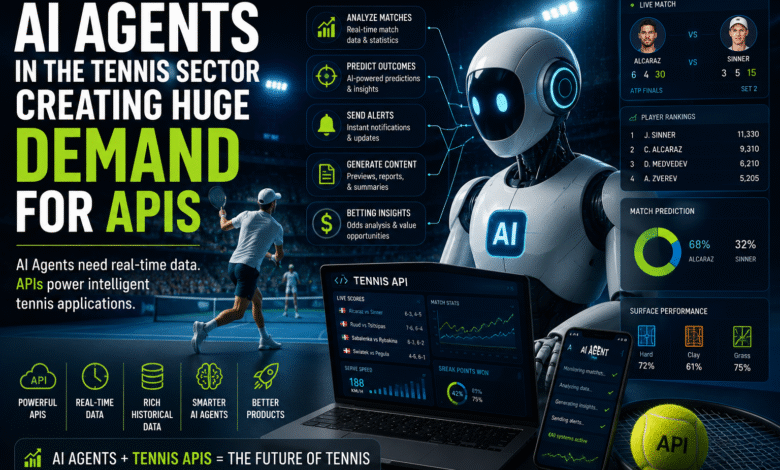
Unlike standard AI systems that simply answer questions or generate content, AI agents can perform tasks, gather information, make decisions, and interact with multiple systems automatically. They can monitor live matches, analyze player performance, generate reports, create predictions, send alerts, update databases, and even communicate with users without constant human intervention.
As AI agents become increasingly capable, they are creating a massive surge in demand for tennis APIs.
The reason is simple.
AI agents need data. Lots of data. And the fastest, most reliable way to provide that data is through APIs.
What Are AI Agents?
Most people are familiar with AI chatbots such as ChatGPT.
A chatbot responds when a user asks a question.
An AI agent goes much further.
An AI agent can continuously monitor information, gather data automatically, analyze incoming events, make decisions, and trigger actions without waiting for instructions.
For example, a tennis AI agent could monitor every ATP and WTA match being played globally and instantly notify users when unusual patterns emerge.
Another agent could generate betting insights before matches begin.
A third could automatically produce match previews, player reports, and statistical summaries.
All of these applications require a constant stream of structured tennis data.
Why Tennis Is Perfect for AI Agents
Tennis is uniquely suited to AI-driven applications.
Unlike many sports, tennis produces highly structured and measurable information. Every match generates live scores, rankings changes, player statistics, surface performance metrics, historical comparisons, and detailed head-to-head records.
Because there are only two competitors involved in most matches, AI systems can analyze matchups more effectively than many team sports.
This makes tennis an ideal environment for intelligent automation.
As AI agents become more common, demand for comprehensive tennis data feeds is increasing rapidly.
The New Generation of Tennis Applications
Historically, tennis applications were fairly simple.
Most websites focused on live scores, rankings, tournament schedules, and match results.
Today’s applications are becoming significantly more sophisticated.
AI-powered tennis platforms increasingly provide automated predictions, match previews, player comparisons, betting insights, statistical analysis, and personalized recommendations.
Many of these features are no longer generated manually.
They are being produced by autonomous AI agents operating behind the scenes.
The result is a significant increase in API consumption.
AI Agents Never Stop Working
One major difference between traditional software and AI agents is that agents operate continuously.
A human analyst might review a handful of matches each day.
An AI agent can monitor thousands of matches, rankings updates, odds movements, and statistical changes simultaneously.
This creates enormous demand for real-time data.
Every time an agent evaluates a player, a tournament, a ranking change, a live match, or a betting market, it consumes information from one or more APIs.
As more businesses deploy AI agents, the volume of API requests increases dramatically.
Tennis Prediction Agents
One of the fastest-growing categories is prediction agents.
These systems continuously evaluate matches and attempt to forecast outcomes.
To operate effectively, prediction agents often require historical match results, rankings history, recent form, head-to-head records, tournament performance, and surface-specific statistics.
The larger the dataset available, the more sophisticated the predictions can become.
This is one reason why tennis API providers are seeing growing demand from developers building AI-powered prediction products.
Betting Agents Are Driving API Growth
Sports betting is another major driver.
AI agents are increasingly being used to monitor odds movements, identify value opportunities, analyze player performance, track market sentiment, and generate betting recommendations.
Unlike traditional models that run periodically, many betting agents operate continuously throughout the day.
This requires constant access to live scores, rankings, historical results, odds data, and statistical databases.
Every additional agent creates more API traffic.
As AI adoption accelerates across betting companies, demand for tennis APIs is rising alongside it.
Automated Tennis Content Creation
Sports publishing is also changing rapidly.
AI agents can now generate match previews, tournament summaries, statistical reports, player comparisons, and daily newsletters.
A tennis media company that once employed multiple analysts to create content can now use AI agents to produce large volumes of information automatically.
Many of these publishers rely on dedicated data services and resources such as tennis api news to stay updated with new datasets, coverage improvements, and emerging AI-focused tennis data products.
The agents do not create the information themselves.
They rely on data sources.
This creates another major source of demand for tennis APIs.
Without reliable data feeds, automated content generation becomes impossible.
Tennis Coaching and Performance Agents
Professional coaching is another area experiencing rapid adoption.
Modern AI agents can assist coaches by monitoring player trends, identifying weaknesses, comparing opponents, evaluating performance patterns, and generating tactical reports.
For example, an agent could automatically identify that a player’s second-serve performance has declined over the last ten matches on hard courts.
Previously, an analyst might spend hours finding this information.
Today, an AI agent can generate the insight instantly.
However, this capability depends entirely on access to comprehensive tennis statistics.
Personalized Tennis Assistants
Many experts believe personalized AI assistants will become common in sports over the next few years.
Imagine asking:
Who is most likely to win today’s Alcaraz match?
Or:
Show me players with the strongest grass-court records this season.
The AI assistant could instantly gather information, analyze relevant statistics, compare historical performance, and provide a detailed answer.
To do this effectively, the assistant requires access to large amounts of tennis data.
Every user interaction becomes another source of API demand.
Why Historical Data Matters
One of the biggest misconceptions about AI agents is that they only need live information.
In reality, historical data is often even more valuable.
AI agents use historical information to identify long-term trends, performance cycles, ranking progression, surface preferences, and tournament history.
The richer the historical database, the more useful the agent becomes.
This explains why many developers increasingly prioritize APIs that provide deep historical coverage rather than simply live scores.
The Rise of Multi-Agent Tennis Systems
The future is likely to involve multiple specialized agents working together.
A single tennis platform may eventually use a live-score monitoring agent, a prediction agent, a content generation agent, a betting analysis agent, and a player research agent.
Each agent may consume different types of tennis data.
Collectively, these systems can generate thousands or even millions of API requests.
This creates substantial growth opportunities for data providers.
What Happens Next?
The growth of AI agents within tennis is still in its early stages.
Over the next decade we are likely to see autonomous prediction platforms, personalized tennis assistants, automated coaching tools, AI-generated tennis media, smart betting agents, and advanced player analysis systems.
Every one of these innovations will require data.
And most of that data will be delivered through APIs.
As AI agents become more powerful, their appetite for information will continue to grow.
Final Thoughts
Artificial intelligence is already transforming tennis, but AI agents may ultimately have an even bigger impact than traditional machine learning systems.
These agents can monitor matches, generate predictions, create content, analyze players, and interact with users around the clock. Unlike human analysts, they never stop working.
The common factor behind all of these applications is data.
Live scores, rankings, historical matches, head-to-head records, player statistics, tournament results, and odds information are becoming essential inputs for modern AI systems.
As more companies deploy AI agents throughout the tennis ecosystem, demand for high-quality tennis APIs is likely to increase dramatically. In many respects, APIs are becoming the infrastructure layer that enables the next generation of intelligent tennis products.
The AI agent revolution is only beginning, and the companies providing rich tennis data may become some of its biggest beneficiaries.
“`