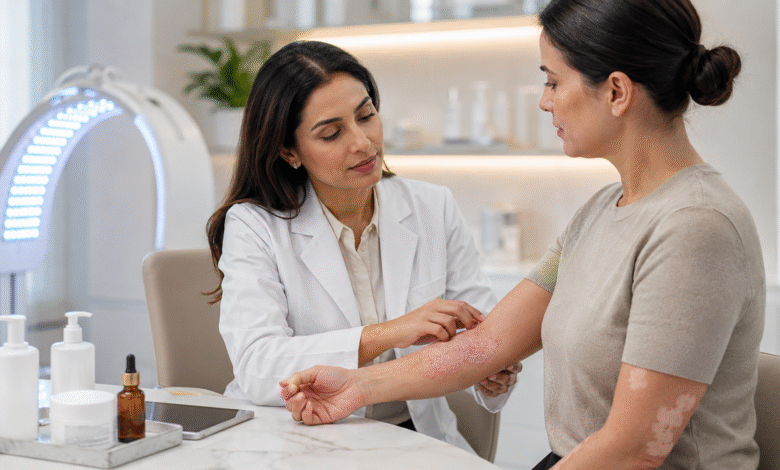
Chronic skin disease lands millions of people across the UK and Europe in dermatology clinics every year. Psoriasis, eczema, vitiligo, and a long tail of less common conditions account for most of the visits. The old answer was steroid creams plus oral immunosuppressants, with all the fun that entails: thinned skin, awkward rebound flares, infection risk.
The good news is the playbook has shifted. There’s a real menu of non-invasive options now, and the bar for what counts as “first-line” is changing pretty fast. A few of these tools have been around forever and just got better hardware; others are genuinely new.
Light Therapy Quietly Carries the Load
Narrowband UVB phototherapy is the workhorse here. It uses a sliver of UV around 311 to 313 nanometers, which sounds technical, but the practical effect is that it slows down the runaway skin cell turnover behind plaque psoriasis without burning the surrounding tissue. NICE recommends it as a standard option for moderate to severe psoriasis, and studies show a 75% PASI improvement in over half of patients after eight to twelve weeks.
Sessions are quick. Three times a week, a few minutes each, either at a clinic or at home with a prescription unit. The LITE trial (783 patients) found home compliance was about 3x better than clinic-based treatment, which surprised exactly nobody who has ever sat in an NHS waiting room.
So why has this aged so well? If anyone is curious about what is phototherapy doing at the cellular level, the picture is that UVB suppresses DNA synthesis in overactive keratinocytes and dials down local T-cell signaling, with no oral drug, no liver metabolism, and no body-wide hit. It’s basically the opposite of a sledgehammer.
The technique isn’t even close to new. Per Wikipedia’s light therapy article, Niels Finsen won a Nobel for using UV to treat lupus vulgaris in 1903. The wavelengths are tighter now and the bulbs cooler, but the basic idea has held up.
Topicals Worth Talking About
Steroids still anchor the topical world. They work, they’re cheap, and they’re familiar. But the problems show up after years of using them on the same patches: thinned skin, telangiectasia, eventual rebound flares.
Calcineurin inhibitors (tacrolimus, pimecrolimus) are go-to alternatives for the face, eyelids, and skinfolds where steroids cause the most trouble. No skin thinning, no telangiectasia. They sting a bit going on, but most patients adjust.
JAK inhibitor creams are the newer thing. Ruxolitinib in particular has been approved for atopic dermatitis and vitiligo, blocking inflammatory signalling without dosing the rest of the body. Harvard Health Publishing has been tracking how this category is reshaping the older steroid-or-systemic decision tree.
And the unsexy stuff still matters too. Ceramide-based moisturisers applied twice daily cut eczema flare frequency by roughly half, and dilute bleach baths (yes, that’s real, and it actually works) twice a week reduce the staph load that drives infected flares. Cheap, ugly, effective.
Lasers, Cold Plasma, and Other Strange Ideas
Excimer lasers fire 308 nm UVB at individual plaques. Localised psoriasis often clears in around 10 sessions, and the surrounding healthy skin stays untouched. Useful for people with two or three stubborn patches who don’t want a whole-body treatment.
Cold atmospheric plasma is the genuinely weird one. It’s ionised gas at near-room temperature, generating reactive oxygen and nitrogen species that kill bacteria, jumpstart wound healing, and (in some studies) calm psoriatic plaques. The clinical evidence keeps growing, including IEEE-published research on decontamination effects in real skin tissue, with CE-certified devices like PlasmaDerm and kINPen MED already in European wound care for years.
Smart practice isn’t loyalty to a single tool. Most dermatologists combine approaches: phototherapy paired with a topical JAK, or steroid-sparing creams layered onto consistent emollient routines. Skin disease is messy, and treatment plans usually should be too.
Where This Goes Next
Expect AI-assisted phototherapy dosing, more selective JAK creams without the safety baggage, and home devices that look less like medical equipment and more like consumer tech. LED arrays are already replacing fluorescent UV tubes, which is better for both precision and electric bills.
The bigger question is access, not science. NHS pathways, GP referrals, and stubbornly long dermatology waiting lists will decide who actually benefits from what’s now possible. Anyone tired of bouncing between systemic drugs and disappointing creams should ask a dermatologist what these newer non-invasive options would look like for their case.