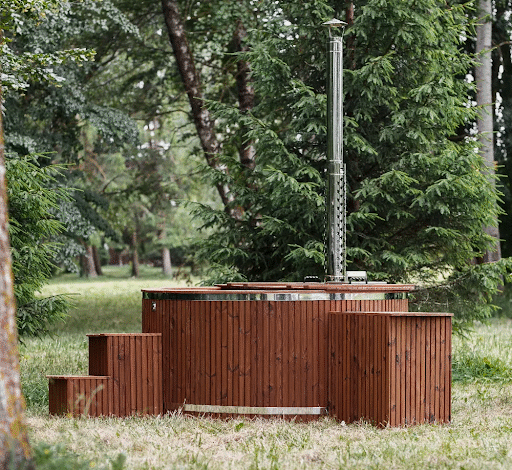
A wood-fired hot tub works by burning logs in the submerged or external stove to heat water. It doesn’t require electricity or have running costs for heating, which is why many opt for these tubs instead of plug-in spas. You’ll get a price range of about 2,500 to 7,000 pounds considering the material and size, heating time from cold approximately two to four hours, and factors like a level base, a nearby log supply, and regular water changes as most models operate without filtration or chemicals. These tubs are perfect for those who are enthusiastic about rituals and low operating costs; they are not for people who desire instant, hands-off convenience.
The trade-off is the main issue in the center of the decision. You give up the push-button simplicity of an electric spa and assume the task of lighting a fire and controlling the heat, but in exchange, you get lower operating costs, a more natural soak, and a tub that can be placed anywhere without a dedicated electrical supply. This trade-off depends almost entirely on how you imagine using it.
How does a wood-fired hot tub actually work?
The concept is very old and quite straightforward. A wood-burning stove, whether it is placed inside the tub or set externally right next to the tub, heats the water directly through metal walls and natural convection brings the heat as hot water being lighter goes up and cold water being heavier goes down. Stoves placed inside heat more rapidly as the firebox becomes immersed in the water, whereas stoves placed externally require a bit more time. However, they are not only the least intrusive option when it comes to space inside the tub but to also keep the flames away from bathers. The heating duration is influenced by how much water you want to heat, at what temperature you are starting, and how cold the air outside is.
For example, a standard unit with a capacity of approximately 1,000 to 1,500 liters will take from about two to four hours to be able to provide a comfortable 38 degrees water temperature starting from the water coming from the tap at a cold temperature, and of course, a lot longer if it is a day when it is freezing outside. You supply the fire, then wait, and besides, you are supposed to stir the water once in a while so that the temperature becomes even everywhere because wood-fired tubs if left completely still heat up quite unevenly. One does not become an expert in heat control right from the beginning. The heat management skills are refined through experience after having attended a few sessions. Besides, at first, a major portion of people end up making a mistake in the sense of too much heat; Because of this, most owners end up getting to the stage of no longer putting logs before hitting the target and allowing the residual heat to do the rest.
The two really useful items, that you will be using every time, are a simple thermometer and a paddle for stirring.
What does it cost to buy and run?
Initial investment is closely linked with the choice of material. Basic models, typically constructed from softwood like spruce or larch and equipped with a fibreglass or plastic liner, are priced from 2,500 to 3,500. Meanwhile more resilient thermowood, cedar tubs or those having a stainless steel or fibreglass interior would cost somewhere between 4,000 and 7,000 or even more. The liner is just as important as the timber since a lined tub is not only much easier to clean but also better at resisting leaks than bare wood which depends on swelling for its water-tightness.
Operating expenses are where these tubs stand out. Since there is no electric heater running 24/7 to keep the temperature stable, your only fuel expense will be the wood itself, and one heat-up usually consumes roughly 15 to 30 kilograms of logs. When you are getting or processing your own wood, the cost per soak could be almost zero, which is completely different from an electric spa that could add 30 to 70 to your monthly energy bill. The efforts and cost to maintain them is less but you have to be more actively involved. A large number of individuals operate their tubs without chemicals, based on the drain-refill interval of 1 to 3 times to keep the freshness level that usual depends on the number of people bathing and their cleanliness before the bath.
You can use filtration and sanitizer to increase water lifespan, but then the configuration will be more analogous to an electric spa from the point of view of the complexity and cost, which actually negates part of the attractiveness for pure tub aficionados.
What do you need in your garden before it arrives?
Groundwork is the first step and it is very important. For example, a filled bathtub plus bathers weighs well over a ton, so it should have a level, load-bearing base. Typically, paving slabs, a concrete pad, or compacted gravel are used for that purpose. Never soft lawn, which will sink unevenly. If the base is not level, the water will be lopsided and it will put stress on the structure over time. This is the single most common reason for regret.
Basically, fire safety and clearance determine the layout. Because a stove and its flue get quite hot, it is necessary to have a non-combustible ground around the firebox and a reasonable distance to fences, sheds, and overhanging branches. You should place the tub for the smoke drifts away from both your house and your neighbours. Besides that, you have to check whether you are not breaking any local garden fire rules or smoke-control area regulations, you will probably find in the parts of many British towns and cities.
Most people will overlook water and wood logistics only when they get one. Actually, you will be filling the tub using a garden hose, so having a nearby tap will save you quite a bit of dragging. Then again, emptying will be quicker if the base is a bit elevated compared to the ground all around or near a drain. Wood fuel should be kept dry and stored covered within a few steps so that your wood supply will be well-seasoned and ready for use. After all, burning wet wood that is wet is a misery and so it produces more smoke.
Which type and material suits your situation?
Your household and frequency of use should control the selection. Bigger families and those who regularly entertain need a larger tub with an external stove and fibreglass liner, as it not only seats more people but also keeps the firebox out of the way and is easy to clean between the regular water changes that heavy use entails. Couples or casual users can quite comfortably run a smaller, simpler internal-stove model and be prepared for a slightly more involved cleaning.
Material decides longevity and upkeep. Spruce is the cheapest, but the least durable, larch and thermowood handle British damp better and resist rot, and cedar sits at the premium end with natural weather resistance and a pleasant scent. When you are comparing models, it is worth looking at specialist ranges of wood fired hot tubs built for the climate here, because a tub designed for wet, cold winters with quality timber and a proper liner will outlast a cheap import that warps and leaks within a couple of seasons.
Climate also affects the way people use things. For instance, for a wood-fired hot tub, it really gets its moment in a cooler, wetter British garden during autumn and winter. This is the time when doing the fire and soak ritual feels the best, and even the long heating time is turned into an integral part of the evening rather than a boring task. However, if you are just envisioning sudden summer swimming, then the heating time might be a source of irritation for you, and a model powered by electricity could suit your lifestyle better.
Is the ritual worth the effort for you?
It’s really this simple question that determines the satisfaction level. A wood-fired tub should not be viewed simply as a convenience purchase; rather, it is a thorough ritual that is chosen by people who love, on lighting the fire, watching the temperature rise, and finally, seeing the whole process as a part of their relaxation instead of being an obstacle to it. In fact, if you want to step out of your home and be soaking within ten minutes, the wait will become annoying very quickly.
The result, with the proper owner, is something that an electric spa is not capable of duplicating. There is a quiet pleasure of fire crackling next to warm water on a cold night, no humming pump, no monthly running-cost dread, just logs and heat and steam coming to the dark. Many owners talk about the heating ritual being the part they never thought they would enjoy so much that they ended up valuing it the most.
Before signing that dotted line, give a few fires a chance this winter and see whether the act of tending a fire helps you relax or annoys you, as that one single reaction tells how frequently the tub is going to be used. A wood-fired hot tub rewards those who are patient and punishes the impatient ones, so only purchase it for the version of yourself who really wants to slow down, not the one who just wishes they did.