For businesses operating within a highly competitive environment in the manufacture of products and delivery of services, sustaining quality is essential for success. Many organizations are adopting quality management systems software as it is a way to solve what is one of the greatest challenges they face. Non-conformance occurs when there is a failure by products or services to conform to specific requirements, leading to significant losses in terms of costs associated with rework and customer satisfaction for firms. Quality management software systems have become one of the greatest ways for organizations to deal with non-conformance issues.
Understanding Non-Conformance in Modern Operations
Non-conformance problems exist almost everywhere within all industries and business processes. For instance, if there is a manufacturing flaw in the electronic part of a product, a paperwork mistake in a hospital, a service problem in a hotel or restaurant, or a violation of compliance requirements in banking, such non-conformance is an indication that something has gone wrong. Such cases do not just reflect an occasional problem but rather a systemic problem with the system’s process, equipment, people, training, or quality management software.
Traditional approaches to managing non-conformity have been centred on reacting to the situation, diagnosing why it happened, correcting it, and then making sure that the problem does not repeat. This strategy is essential, although inherently restrictive in terms of its effectiveness. The fact is that by the time non-conformity is detected through standard quality inspections, the damage has usually been done. Goods have been delivered to their customers, violations of legal requirements have been committed, and efficiency issues have already become a systemic problem.
Financial repercussions of not conforming to standards are enormous. Research shows that bad quality leads to expenses from 5% to 30% of revenues, depending on industry and the degree of the problem. Expenses consist of such factors as scrapping products, work related to reworking, expedited delivery, return goods allowance, warranty costs, fines, and damage to the reputation. If we take a mid-size production company with a yearly turnover of $100 million, it will incur at least $5 million in expenses just because of poor product quality.
The Evolution of Quality Management Software
The evolution of quality management from manual to computerized approaches is one of the most revolutionary changes in modern-day management operations. Earlier quality management applications were largely document management systems that would store procedure documents, test results, and other relevant information. While these systems served their purpose, they did not offer many real-time advantages for managing quality performance, nor could they predict future problems with quality.
Generation of quality management software today has advanced significantly when compared to older generation software. The generation of quality management software makes use of data available from different sources, like machines in the factory, laboratories, testing centres, suppliers, and consumers, in order to achieve total visibility of quality throughout its life cycle. Advanced quality management software makes use of technologies like AI and machine learning to analyze quality data.
Key Capabilities of Advanced Quality Management Software
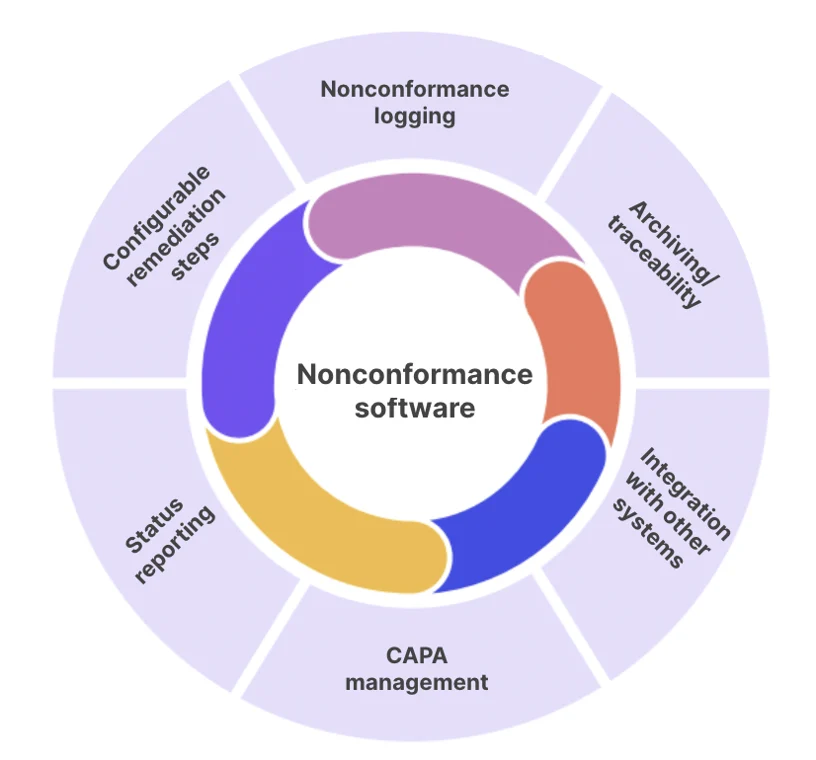
1. Real-time gathering and analysis of data- The quality management software tools collect real-time data during manufacturing processes, eliminating the delay that results from manual data collection. By analyzing the stream of data collected in real time, the system will be able to determine any trend or risk that may result in the production of defective products. Using prediction tools, it is possible for the system to predict any issues associated with equipment failure and process deviation.
2. Traceability and genealogy management- Even if non-conformances occur, the system helps trace all affected products with the aid of the traceability function. It is then possible to determine what components have been used to manufacture the specific products or batches.
3. Automation of Deviations Control- With the help of quality management software, the entire deviation control process can be automated, from the moment when the deviation is identified through analysis of the reasons behind the problem, correction of the mistake, and testing of the applied solution. In this way, all deviations are managed in a timely manner, and no delays occur due to human error.
4. Integration with Supplier Quality Control- As there are a lot of non-conformities resulting from problems in supplier quality management, the introduction of advanced quality management software can be used to solve this issue. With this technology, it is possible to establish quality standards in cooperation with the supplier and evaluate the quality of goods delivered by the supplier. Joint continuous improvement programs can also be developed.
5. Compliance with Regulations and Reporting- Using quality management software, it becomes possible to monitor the process of quality assurance and create all the required documentation for compliance with industry regulations. All quality standards will be met in accordance with established regulations.
6. Reporting and Business Intelligence- Modern software in quality management transforms simple quality information into complex systems for reporting and business intelligence, which makes it easier for management and even operators to understand and utilize them effectively. Analytics, trend analysis, process control charts, and KPIs enable all parties, especially decision makers, to get an overall picture of the quality performance. Effective business intelligence enables efficient decision-making and quality management.
Implementing Quality Management Software Successfully
Implementation of software for quality management cannot simply entail the implementation of the technology itself. Implementation should be well planned; one of the first things to consider would be the analysis of current processes, including problems and methods to improve them. Such analysis would have to involve all the relevant parties, including people in charge of such functions as quality, operations, engineering, procurement and logistics, and regulation.
One thing that must be taken into account is how the software would immediately add value through its implementation. Training plays an integral part in this process which helps in change management. The integration of the QMS with other enterprise systems, like the ERP platform and MES system, would allow the user to get the maximum benefit from implementing the new software. The absence of integration between the quality management system and other IT systems would create inconsistencies and inefficiencies.
Measuring the Impact of Quality Management Software
Effective implementation of quality management software is always followed by numerous improvements in the majority of key performance indicators. Firstly, the defect rate can be decreased within the 20-40 % range owing to the ability to monitor processes in real time. Secondly, the cost of quality decreases within the 15-25 % range since the relation between expenses incurred on quality assurance and expenses incurred on correction activities turns more positive.
Customers’ satisfaction levels tend to improve due to an improvement in quality. Auditors’ findings are dramatically reduced. Supply chain efficiency increases due to more sophisticated demands toward suppliers, faster response times, and quality improvement collaboration. Finally, one of the most significant advantages of software implementations is that it helps companies develop a quality culture. When access to quality information becomes available to all members of the organization, everyone assumes personal responsibility for quality.
Conclusion
The implementation of advanced quality management software represents a paradigm shift away from conventional methods used to address quality assurance and prevent non-conformities. By utilizing the system to track data, automate processes, predict future results, and collaborate, the root cause of non-conformities is addressed rather than merely addressing the symptoms. Quality management software will continue to improve in the future and integrate technologies like artificial intelligence.