Modern businesses rely on complex IT environments involving cloud platforms, databases, servers, applications, and network infrastructure. When these systems experience performance problems, even a short disruption can affect productivity, customer experience, and business operations.
To maintain reliable services, organizations need monitoring systems that identify performance issues, track infrastructure health, and generate actionable alerts.
However, choosing between enterprise monitoring and open-source monitoring is not always straightforward.
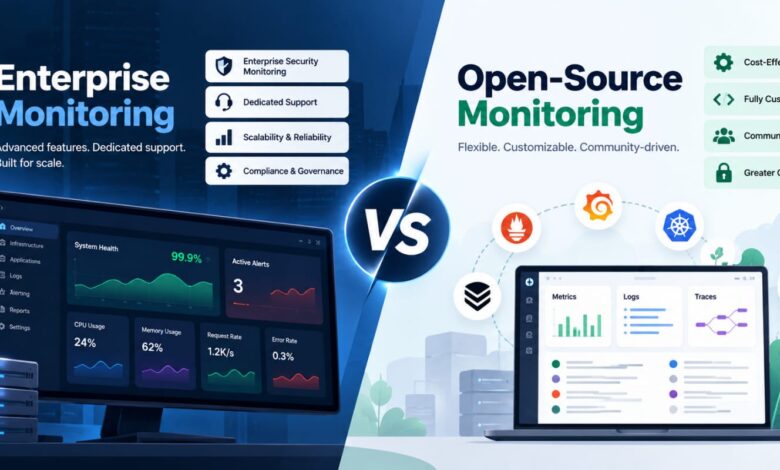
An enterprise monitoring tool may offer dedicated technical support, advanced security capabilities, and additional management features. Open-source alternatives provide flexibility, customization, and greater control over software deployment.
This article explains their key differences, advantages, limitations, and how businesses can select appropriate monitoring solutions in 2026.
What Is Enterprise Monitoring?
Enterprise monitoring is the process of tracking the availability, performance, and health of IT systems across large or complex business environments.
Organizations use monitoring platforms to collect operational data from servers, databases, cloud applications, network devices, and other infrastructure components.
These platforms help IT teams identify abnormal behavior, investigate performance problems, and respond to service disruptions.
Commercial enterprise monitoring solutions commonly provide additional capabilities, such as dedicated support, advanced access controls, long-term maintenance, and service-level agreements.
Key Features of Enterprise Monitoring Tools
An enterprise monitoring tool may include:
- Centralized infrastructure monitoring dashboards
- Automated alerts and incident notifications
- Performance metrics and historical reporting
- Role-based access controls
- Integration with cloud and on-premises infrastructure
- Enterprise support and maintenance agreements
- High availability and scalability features
These capabilities are particularly important for organizations managing critical services across multiple departments or geographic locations.
What Is Open-Source Monitoring?
Open-source monitoring uses software whose source code is publicly available under an open-source license.
Organizations can deploy these solutions, configure their monitoring environments, and integrate them with other technologies.
Popular examples include Prometheus, Zabbix, Nagios Core, and community editions of VictoriaMetrics.
Open-source monitoring can provide infrastructure metrics collection, alerting, service availability checks, and performance analysis.
The main advantage is flexibility. Businesses can adapt monitoring configurations to their technical requirements without depending entirely on proprietary software.
However, open-source monitoring still requires infrastructure resources, maintenance, and technical expertise.
Enterprise Monitoring vs Open-Source Monitoring: Key Differences
Both approaches help organizations maintain visibility into IT infrastructure. Their main differences involve support, operating responsibilities, advanced features, and deployment flexibility.
| Feature | Enterprise Monitoring | Open-Source Monitoring |
| Software cost | Often requires a commercial license | Usually available without license fees |
| Technical support | Vendor support and possible SLAs | Community support or optional paid services |
| Customization | Depends on the vendor | Often highly customizable |
| Security features | May include advanced access controls and compliance features | Depends on the project and configuration |
| Scalability | Designed or supported for production growth | Depends on architecture and deployment |
| Maintenance | Vendor assistance may be available | Primarily managed by internal teams |
| Implementation | May include professional services | Usually requires internal expertise |
An important distinction is that enterprise and open-source monitoring are not mutually exclusive.
Many organizations use open-source technology with commercial support and enterprise-specific extensions.
Benefits of Enterprise Monitoring Tools
1. Centralized Infrastructure Visibility
Enterprise monitoring platforms can provide a unified view of different IT systems.
Administrators can track infrastructure performance, system availability, and service health through centralized dashboards.
This helps teams identify operational problems without reviewing every server or application individually.
2. Dedicated Technical Support
Commercial monitoring platforms often provide support services for troubleshooting, deployment, and system optimization.
Organizations operating critical infrastructure may benefit from access to experienced engineering teams when unexpected failures occur.
Support availability and response guarantees depend on the purchased agreement.
3. Scalability for Growing Infrastructure
Enterprise environments frequently generate large amounts of monitoring data.
Monitoring platforms must handle increasing numbers of applications, servers, containers, and infrastructure metrics.
Features such as distributed architectures, data retention controls, and high availability can help support growing workloads.
4. Advanced Security and Governance
Enterprise platforms may offer stronger access management, authentication integrations, and security maintenance commitments.
These capabilities are especially relevant when multiple departments access shared monitoring systems.
However, security still depends on implementation, configuration, and ongoing operational practices.
Benefits of Open-Source Monitoring
Cost Flexibility
Open-source software can reduce or eliminate licensing expenses.
This makes it attractive for startups, small businesses, and organizations with limited IT budgets.
However, hosting, maintenance, storage, and engineering effort still contribute to total operating costs.
Customization and Integration
Organizations can adapt open-source monitoring configurations to suit their infrastructure.
Tools such as Prometheus and Grafana also integrate with numerous cloud-native technologies.
This flexibility can be valuable for teams managing custom applications or specialized infrastructure.
Transparency and Control
Access to source code allows technical teams to inspect software behavior and understand how components operate.
Self-hosted deployment can also give organizations greater control over their monitoring data and infrastructure.
Community Development
Established open-source projects benefit from communities that contribute documentation, integrations, and software improvements.
The quality of support varies between projects, so businesses should evaluate community activity and maintenance practices before selecting a platform.
How Enterprise Security Monitoring Protects IT Infrastructure
Enterprise security monitoring involves detecting and investigating activities that may indicate security threats, policy violations, or unauthorized access.
It complements infrastructure performance monitoring but serves a different primary purpose.
Performance monitoring focuses on availability, latency, and resource utilization. Security monitoring examines authentication events, suspicious behavior, access patterns, and potential incidents.
Organizations may collect security-related information such as:
- Failed login attempts
- Unauthorized access requests
- Unusual network activity
- Unexpected configuration changes
- Suspicious application events
These signals can help security teams investigate potential threats.
However, conventional infrastructure monitoring tools do not automatically replace specialized security information and event management (SIEM) platforms.
Businesses should select dedicated security capabilities according to their threat detection and compliance requirements.
Enterprise Monitoring and Open-Source Monitoring in Practice
A growing technology company might initially deploy an open-source monitoring platform to track application performance and server health.
As its infrastructure expands, it may need advanced authentication, stronger availability guarantees, longer retention periods, and dedicated operational support.
At this stage, adopting enterprise capabilities can become useful.
For example, VictoriaMetrics Enterprise extends its open-source metrics platform with features such as enterprise authentication, automated backups, advanced data retention controls, anomaly detection, and technical support.
The platform also offers monitoring-of-monitoring capabilities to help organizations identify problems affecting their monitoring infrastructure itself.
This demonstrates how businesses can combine an open-source technology foundation with additional enterprise services.
How to Choose the Right Infrastructure Monitoring Solutions
Selecting suitable infrastructure monitoring solutions requires evaluating current needs and future operational requirements.
Evaluate Infrastructure Complexity
Consider the number of servers, applications, databases, cloud environments, and network devices that require monitoring.
A small infrastructure may operate effectively with a simpler monitoring stack, while distributed environments may require more extensive capabilities.
Calculate Total Cost of Ownership
Compare more than software licensing costs.
Include infrastructure hosting, storage, maintenance, staff expertise, training, and ongoing support.
A free solution may become expensive if maintaining it requires substantial engineering resources.
Review Security Requirements
Determine whether the organization requires advanced authentication, access controls, audit capabilities, or compliance support.
Confirm that the selected platform can meet those requirements rather than assuming enterprise branding guarantees compliance.
Test Scalability and Reliability
Evaluate how the monitoring system performs under expected data volumes.
Consider metrics ingestion, query performance, retention periods, backup procedures, and failure recovery.
Assess Available Technical Support
Organizations with experienced infrastructure engineers may be comfortable operating open-source systems independently.
Teams responsible for critical services may prefer dedicated vendor assistance and contractual support.
Enterprise Monitoring vs Open-Source Monitoring: Which Is Better?
Neither approach is universally better.
Open-source monitoring is often suitable for organizations that prioritize flexibility, customization, and control over deployment costs.
Enterprise monitoring may be preferable when businesses require dedicated technical support, advanced governance capabilities, predictable maintenance commitments, and specialized production features.
The most practical approach can also combine both models.
For example, an organization may begin with open-source monitoring components and introduce enterprise support as operational requirements become more complex.
The decision should depend on infrastructure needs, internal capabilities, and the business impact of monitoring failures.
Best Practices for Implementing Monitoring Systems
Whether using enterprise or open-source software, organizations should follow consistent monitoring practices.
Define meaningful metrics: Track availability, response times, error rates, and resource utilization according to business priorities.
Configure actionable alerts: Prioritize conditions that require investigation rather than generating notifications for every minor performance change.
Monitor the monitoring system: Track data collection failures, storage capacity, ingestion delays, and alerting reliability.
Protect monitoring data: Apply appropriate access controls, encryption, and retention policies.
Review performance regularly: Update dashboards, alert thresholds, and capacity plans as infrastructure changes.
These practices help organizations maintain dependable monitoring operations regardless of the software model selected.
Frequently Asked Questions
What is an enterprise monitoring tool?
An enterprise monitoring tool tracks the health, performance, and availability of business IT infrastructure. Commercial enterprise offerings may also provide specialized security features, technical support, and operational management capabilities.
Is open-source monitoring suitable for large enterprises?
Yes. Open-source monitoring platforms can support large environments when properly architected, configured, and maintained.
What is the main difference between enterprise and open-source monitoring?
The primary differences typically involve software licensing, support arrangements, maintenance responsibilities, and access to additional commercial features.
Can businesses combine enterprise and open-source monitoring?
Yes. Organizations can use open-source monitoring components alongside commercial support, managed services, or enterprise-specific extensions.
What should businesses consider before selecting monitoring software?
Important factors include scalability, infrastructure compatibility, technical expertise, security requirements, total operating costs, and support availability.
Conclusion
Choosing between enterprise monitoring and open-source monitoring requires balancing flexibility, reliability, security, and operating costs.
Open-source platforms provide customizable monitoring capabilities and greater deployment control. Enterprise offerings can extend those capabilities with dedicated support, advanced features, and additional operational safeguards.
For businesses evaluating an enterprise monitoring tool, the priority should be identifying the monitoring requirements that matter most to their infrastructure.
The right solution is one that provides reliable visibility, supports future growth, and helps IT teams detect and resolve problems efficiently.