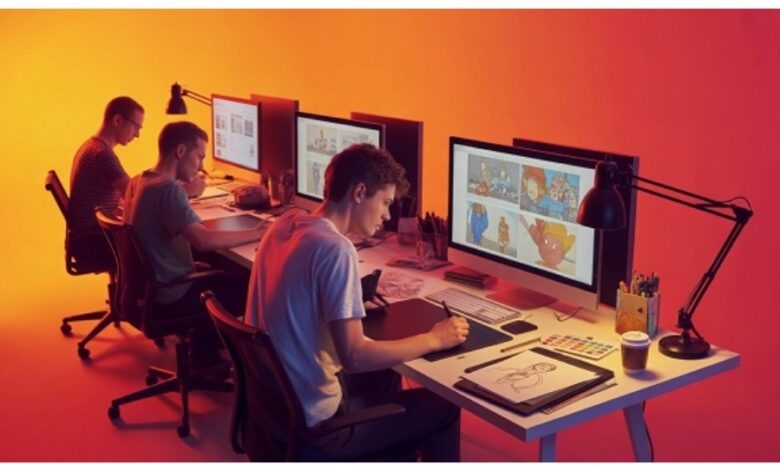
Alt text: Experts working on animation projects
Brands are no longer competing only on product quality or pricing. They are competing on clarity, recall, and emotional connection. In crowded digital spaces, people remember visuals long after they forget taglines or features. This shift has pushed animation to the center of modern brand communication.
What once lived only in television ads or corporate presentations now plays a critical role across websites, apps, onboarding flows, and social media. When used strategically, animation becomes more than decoration. It becomes a language.
Why Motion Communicates Better Than Static Design
Static visuals explain what something looks like. Motion explains how it works and why it matters.
Animation allows brands to guide attention, control pacing, and shape understanding. A viewer does not have to guess where to look or what to read next. The message unfolds naturally.
This is why animated explainer video production has become a preferred choice for brands introducing new products, digital platforms, or complex services. It removes friction by showing ideas in motion rather than forcing audiences to interpret them on their own.
Animation also performs better in environments where attention is limited. On landing pages or social feeds, movement captures interest without demanding effort.
The Role of Explainer Videos in Brand Consistency
Consistency is one of the hardest challenges in brand building. As teams grow and channels expand, messages often become fragmented.
Explainer videos help solve this by acting as a single source of truth. When a brand uses animation to define its story, tone, and positioning, that narrative can be shared internally and externally with minimal distortion.
Explainers are especially valuable for:
- Aligning sales and marketing teams
- Educating partners and stakeholders
- Standardizing onboarding experiences
- Reducing miscommunication at scale
A well-planned explainer becomes a reusable asset that keeps messaging consistent over time.
Why Logo Animation Is No Longer Optional
Logos used to be static symbols. Today, they are expected to move.
On digital platforms, a logo is often the first branded element a user sees. A subtle animation can turn that moment into a lasting impression. Motion adds personality, intention, and memorability to an otherwise familiar mark.
This is why logo animation services are increasingly integrated into brand systems rather than treated as standalone add-ons. Animated logos now appear in:
- App splash screens
- Video intros and outros
- Website loaders
- Social media content
- Presentations and events
When done correctly, logo animation reinforces brand identity without overwhelming it.
What Makes an Effective Logo Animation
Not all logo animations work. Some feel generic, others distracting.
Effective logo animation is guided by the brand’s personality and purpose. It should reflect how the brand wants to be perceived.
Key principles include:
- Simplicity over complexity
- Smooth and intentional motion
- Alignment with brand tone
- Scalability across platforms
- Timeless execution rather than trends
The goal is not to impress, but to be remembered.
Connecting Explainers and Logo Motion Into One System
The most effective brands treat animation as a system, not a collection of assets.
When explainer videos and logo animations share the same visual language, transitions, and motion style, the brand feels cohesive. Viewers may not consciously notice this alignment, but they feel it.
This system-based approach ensures that every animated touchpoint reinforces the same identity, whether someone is watching a full explainer or a three-second logo reveal.
Where Animated Content Delivers the Highest ROI
Animation is often misunderstood as expensive or experimental. In reality, it delivers strong returns when applied in the right places.
High-impact areas include:
- Homepage introductions
- Product walkthroughs
- Brand launch campaigns
- Investor and pitch presentations
- Paid social and video ads
Because animation is adaptable, assets can be repurposed and updated without reshooting or redesigning entire campaigns.
Choosing the Right Production Approach
Not every project requires the same level of complexity. The key is matching production depth to business goals.
Strategic animated explainer video production focuses first on messaging and structure, then on visuals. It prioritizes clarity over visual noise and purpose over polish.
Brands that see the best results are those that treat animation as part of their communication strategy, not just a creative task.
The Long-Term Value of Motion in Branding
Animation is not a trend that fades with platform changes. It evolves, but its core value remains the same.
As digital experiences become more interactive and screen-based, motion will continue to play a central role in how brands explain, differentiate, and connect.
Logos will move. Stories will animate. Brands that embrace this shift early build stronger recognition and trust over time.
Conclusion
Animation has moved from being a supporting element to a defining one in modern branding. Explainer videos clarify complex ideas, while animated logos strengthen recognition and recall.
Together, they form a powerful visual language that helps brands stay consistent, memorable, and relevant in an increasingly crowded digital world.