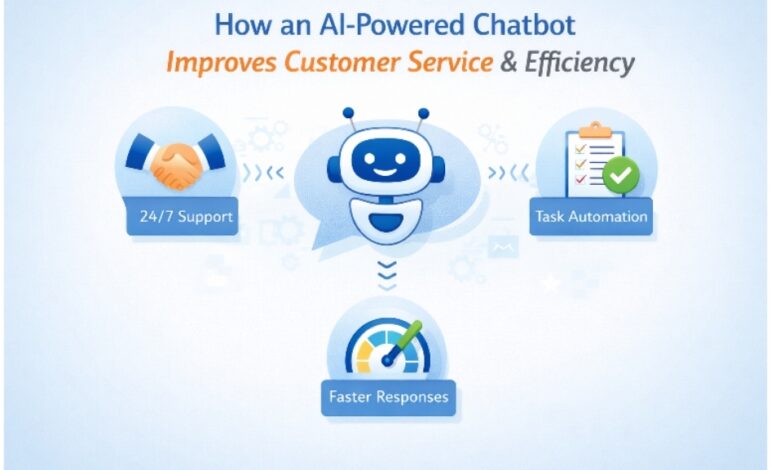
Customer service is no longer judged by how helpful it is. It is judged by how fast, clear, and consistent it feels. Most businesses already have the information customers need. The problem is access. Users wait in queues, repeat questions, or switch between channels just to get simple answers.
An AI chatbot customer service system improves how support works by removing delays and simplifying access to information. Customers can ask questions and get answers instantly without switching channels or waiting in queues. This keeps conversations clear, avoids repeated work, and helps users solve issues faster without unnecessary steps.
Instant, 24/7 Support Without Delays
Customers do not think in business hours. They ask questions when they need answers. If they do not get them, they leave. Chatbots solve this by being always available. They respond instantly, no matter the time or volume. Whether it is a product query, service issue, or basic information request, users get answers without waiting.
This matters more than most teams realize. A large share of customer queries happens outside standard working hours. Without chatbots, queries often lead to delays or missed opportunities. Chatbots fix this by replying instantly. Support remains active at all times instead of being limited to business hours.
Faster Resolution With Fewer Steps
Speed is not just about response time. How quickly a problem gets solved matters most. Chatbots simplify the process by reducing the number of steps needed to reach an answer.
They can:
- Answer common questions instantly
- Guide users to the right information
- Trigger actions like order tracking or refunds
- Route complex issues when needed
Repeated questions are answered instantly by an AI chatbot for customer support, so users do not have to wait in queues. This reduces reliance on human agents. Issues are resolved faster, often within seconds. When escalation is needed, all details are already captured, making the process smooth and less frustrating.
Scaling Support Without Increasing Costs
Customer support demand does not stay steady. It rises during campaigns, product launches, or seasonal traffic. Handling this with only human teams requires hiring, training, and added operational effort.
Chatbots remove that limitation. They can handle thousands of conversations at the same time without affecting response speed. This makes scaling predictable.
An AI customer support chatbot helps businesses handle large volumes of queries without hiring more staff. It reduces the load on support teams and maintains consistent service, even during periods of high demand.
The result is simple.
- More conversations handled.
- Less operational strain.
- Better efficiency overall.
Consistency That Builds Trust
In customer service, inconsistency creates confusion. Different agents may provide different answers. Delays can lead to incomplete information. This affects trust. Chatbots solve this by working on structured knowledge.
Every response follows predefined logic, updated data, and consistent rules. This reduces errors and ensures that users receive the same quality of information every time.
A well-trained AI-powered chatbot for customer service ensures:
- Accurate answers
- Clear responses
- Reliable information
This consistency improves customer confidence and reduces the need for repeated clarification.
Personalised Experiences Without Complexity
Customers look for answers that fit their needs. Generic responses are not enough. They want support based on their situation. Modern chatbots use user data, past chats, and behaviour patterns to make conversations more personal.
This allows them to:
- Suggest relevant products or solutions
- Provide context-aware responses
- Guide users based on their journey
In e-commerce environments, this often overlaps with tools like an e-commerce AI chatbot, where support and sales interactions happen together. Personalisation improves engagement. It also improves outcomes. Users are more likely to complete actions when the experience feels relevant and simple.
What the Data Shows
The numbers around chatbot adoption are often presented in isolation. Look closer, and they reveal a transition in how customer support is fundamentally structured.
From Volume Handling To Workload Reallocation
Up to 80% of routine queries being automatable is not just an efficiency metric. It exposes how much of the support is operationally repetitive. The real implication is not cost reduction, but redistribution. Human agents are no longer the first line of response. They become escalation layers.
From Experimentation To Scaled Adoption
The fact that ~30% of interactions are already AI-handled in some industries signals maturity, not early adoption. This is where most businesses sit today. Not fully automated, but no longer testing. The gap between 30% and 80% defines the current transformation window.
From Task Automation To System Efficiency
Reducing inefficiencies by 20–30% goes beyond ticket handling. It shows better workflows, fewer handoffs between teams, and faster resolution across integrated systems.
What This Actually Means
These are not standalone improvements. Together, they map a shift from human-dependent, queue-driven support to a system-led model where execution, not effort, defines performance.
From Support Tool to Customer Experience Layer
Customer service is no longer a separate function. It is part of the overall experience. Chatbots sit at the center of this shift. They connect support, sales, and operations into one flow. Users do not need to switch channels or repeat themselves. Conversations continue without breaks.
This shift is already visible in some platforms. Tools like GetMyAI allow businesses to handle conversations, actions, and workflows within a single system. This reflects how chatbots are moving beyond support into a wider interaction layer. The aim is not to replace teams, but to remove delays and connect systems better..
Conclusion: Customer Service Is Becoming Instant and Continuous
Customer expectations have changed. Waiting is no longer acceptable. Repeating questions is frustrating. Delayed answers lead to drop-offs. Chatbots address these problems directly. They provide instant responses, reduce resolution time, scale support without added cost, and maintain consistency across interactions.
More importantly, they improve how customers experience a business. Because today, customer service is not just about solving problems. It is about how quickly and clearly those problems get solved.