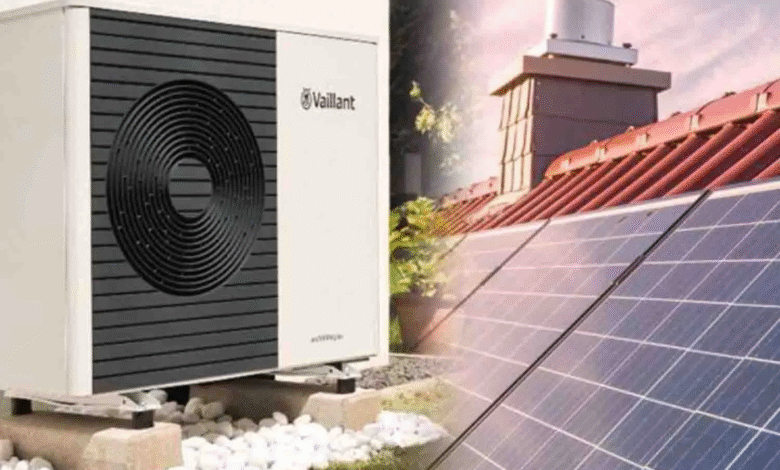
While fuel bills go up and the UK pushes for cleaner heating, house owners are seeking smarter ways to warm their homes. Two technologies are in the spotlight: solar panels and air source heat pumps. Each one on its own can already lower your energy usage. Together, though, they form a winning partnership that can cut your bills sharply and lower your carbon impact.
So, can solar panels be installed with an air source heat pump? Yes. We will explore below how the systems work with each other and how schemes like Air Source Heat Pump Grants UK can help to make it affordable.
How Do Air Source Heat Pumps Work?
An air source heat pump (ASHP) draws heat from outside air and moves it into your home to warm and supply hot water. Despite cold weather, there is sufficient energy in the air for the pump to use.
- For every 1 unit of electricity the pump consumes, it produces 3–4 units of heat.
- This makes it significantly more efficient than a gas or oil boiler.
- It’s electric, so no fossil fuels are being burned inside your home.
But since it’s electric, the running cost depends on the price of electricity, and that is where solar enters the picture.
How Do Solar Panels Work with Heat Pumps?
Solar PV panels use sunlight and turn it into electricity. The power can be put directly into consumption or stored in a home battery system. When coupled with an air source heat pump:
- Daytime power generation: Panels produce electricity, which can power your heat pump directly.
- Decreased grid reliance: Instead of using costly electricity from the national grid, your heat pump is powered by your free solar resource.
- Unused energy consumption: The extra solar power can also drive other appliances, lowering the bills again.
It’s a double win: your heat pump supplies the power, and your solar panels convert it nicely into warmth for your home.
Benefits of Combining Heat Pumps and Solar Panels
- Lower Energy Bills
Heat pumps already pay for themselves compared with old, inefficient boilers. But solar panels powering them means your bills are reduced even further. Most homes pay much less per month, especially in summer when the sun is shining.
- A Greener Home
Both are renewable. Solar panels reduce reliance on grid electricity (which continues to have a partial fossil fuel base), and a heat pump reduces reliance on gas. Collectively, they reduce your carbon footprint.
- Greater Energy Independence
With rising energy costs, independence through solar energy is comforting. It insulates you from the volatility of the energy market and gives you greater control.
- Long-Term Savings
While upfront costs can be high, the savings build up year after year. Once your system pays for itself, you’re left with much cheaper heating and electricity.
- Boosted Property Value
Homes with renewable heating and solar setups are attractive to buyers. They know they’ll benefit from lower bills, making your property more desirable.
How Much Does It Cost?
The cost will depend on the size of your property, the heat pump installation, and the number of solar panels you need.
- Installation of an air source heat pump: £7,000–£13,000
- Solar panel system (no battery): £4,000–£7,000
- Solar panels with battery storage: £7,000–£11,000
So, a hybrid system would therefore cost between £11,000 and £20,000 upfront. But the good news is that government grants and incentives can cut this sum substantially.
Payback Period: When Will It Save You Money?
A single heat pump will save £300–£500 a year if replacing an extremely old gas boiler, and much more when replacing oil.
Solar panels typically save around £400–£700 a year on electricity bills.
Combined, used together, the saving adds up. Most homes pay back the investment within 8–12 years, depending on usage and energy costs.
Free Grants and Help are Available
One of the biggest barriers is the upfront cost. Luckily, there are schemes to render it cost-effective.
ECO4 Scheme
The ECO4 scheme helps low-income families upgrade their heating. Under this scheme, qualifying households can get the entire installation:
- A heat pump for a free air source
- A free solar panel
- Free insulation upgrades
- Zero upfront cost
For most families, the installation of a heat pump can be covered in full under ECO4.
Air Source Heat Pump Grants UK
Even if you don’t qualify for ECO4, you have options. You may be able to get up to £7,500 in grant aid towards a heat pump through the government’s Boiler Upgrade Scheme in England and Wales.
Although such grants don’t usually cover solar panels, the money you get for free installation of a heat pump under ECO4 may enable you to invest what you would have otherwise in panels.
Can All Houses Accommodate the Two?
Not always. Your home needs to be suitable for both systems.
- Roof suitability: Solar panels need enough unobstructed roof space.
- Home insulation: Heat pumps work best in well-insulated homes (though you can get free insulation for free under the ECO4 scheme as well).
- Heating system compatibility: Heat pumps can work with underfloor heating and high radiators.
Most homes are versatile, but it’s always worth having a professional survey to verify.
The Bottom Line
So, can you combine air source heat pumps with solar panels? The simple answer is yes. It’s actually one of the most effective ways to power your home. With solar panels generating free electricity and a heat pump converting that into usable heat, the combination delivers lower bills, cleaner living, and greater energy independence.
Thanks to schemes like ECO4 and Air Source Heat Pump Grants UK, this powerful pairing isn’t just for the wealthy; it’s becoming accessible to more households across the UK. When managing your system, it’s also useful to know how to turn off a radiator without a thermostatic valve to control heating efficiently.
If you’re serious about cutting costs and future-proofing your home, now is the time to explore this renewable energy duo.