If two PCB assemblers tender for the same board and use identical machines, you could see radically different product failure rates in 12 months. The gap usually isn’t visible on a spec sheet. It shows up in which IPC class they inspect against, how they handle a borderline solder joint, and whether their quoted price already includes the testing your product actually needs. The global PCB assembly market is on track to pass $100 billion in 2026, and a growing share of that volume is going to contract manufacturers rather than in-house lines — which makes knowing how to vet one worth more than knowing how the process works in theory.
What Actually Determines PCB Assembly Quality?
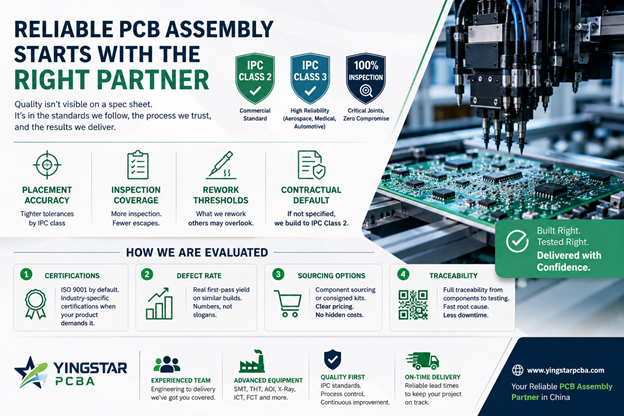
PCB assembly quality comes down to which IPC-A-610 class a manufacturer builds and inspects to, not the age of their equipment or the length of their client list. IPC-A-610 describes three different classes of assemblies – Class 1, the general standard of commercial electronics; Class 2, the “dedicated product” class; and Class 3, the highest reliability, highest criticality class of assemblies. Each class defines defects and acceptability differently. Even a halfway properly wet solder joint with a completed circuit might be acceptable at Class 1 levels but would be an immediate failure at Class 3. Commercial electronics typically require Class 2 by default because it balances acceptable yields with high reliability; Class 3 is mostly for aerospace, medical, and automotive assemblies (and anything that must not fail), not commercial.
If a manufacturer can’t tell you which class they inspect to without checking, note that before the board goes on the line.
Why the IPC Class You Choose Changes Everything Downstream
The class isn’t a paperwork detail — it changes what the assembler will accept, reject, or quietly let through.
- Component placement tolerance. Side overhang allowances shift by class; a placement that’s fine under Class 2 can be a documented defect under Class 3.
- Inspection coverage. Class 3 work typically moves to 100% inspection on critical joints rather than statistical sampling, which raises cost but closes the gap where field failures usually hide.
- Rework thresholds. What triggers a rework order under Class 3 might just get logged as a process indicator under Class 2 — acceptable, but worth monitoring.
- Contractual default. If a Class isn’t called out on paper, most manufacturers will default to Class 2. If your device really requires Class 3, it must be explicit on the assembly drawing, and it doesn’t imply that Class 3 reliability applies.
None of this means Class 3 is always the right call. A consumer gadget with a two-year expected lifespan doesn’t need aerospace-grade solder joints, and paying for that level of inspection on every board is money spent solving a problem you don’t have. The judgment call is matching the class to what actually happens if the product fails in the field.
How Do You Evaluate a PCB Assembly Manufacturer Before Signing a Contract?
How to assess a PCB assembly house on four points: • The level of IPC certification • Their real quality rate on similar products • Will they provide component sourcing in the assembly or separately• The way they assure traceability. Any company that can provide clear, numbered, non-marketing-speak answers to the four questions above is likely your better bet, price aside.
Certifications Tell You What They’re Built For, Not Just What They Can Do
ISO 9001 is close to table stakes now. What differentiates manufacturers is the specialty layer on top of it — ISO 13485 for medical devices, AS9100 for aerospace, IATF 16949 for automotive. A shop without the certification your industry requires can still do the work. Still, you then have to verify quality yourself instead of relying on an audited system that already does it.
Defect Rate Is a Number, Not a Slogan
Ask for an actual first-pass yield or defect-rate figure on a build comparable to yours in volume and complexity, not a general claim about quality. A manufacturer with nothing to share here, or one that offers only a percentage with no context for what it’s measured against, hasn’t been asked the question often enough to have a real answer ready.
Sourcing and Traceability Determine What Happens When Something Goes Wrong
Some manufacturers purchase and stock components on your behalf; others expect a fully consigned kit and just assemble. Neither is right, but they will give very different prices, and the cost of whatever that is needs to be itemised, and shouldn’t be an unexpected invoice line. Also (this is completely separate; do it as another question), do you have serial-number traceability from component to machine parameters through to the test result of a particular board? That record is what turns a field failure six months out into a five-minute root-cause lookup instead of a guessing game across an entire production run.
Conclusion
The manufacturers that produce consistently reliable boards aren’t necessarily the ones with the newest pick-and-place lines — they’re the ones who can tell you their IPC class, their defect rate, and their traceability process without hesitation. Before your next quote request, ask those three questions directly, and treat a vague answer to any of them as the actual red flag, not the price on the quote itself.