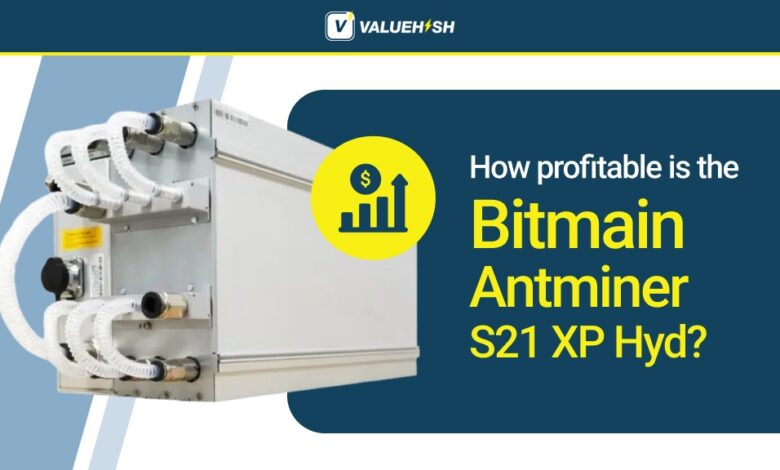
Quick answer: At current market conditions (Bitcoin near $78,000 and hash price around $38/PH/day), a Bitmain Antminer S21 XP Hyd generates roughly $18/day in gross Bitcoin revenue. After electricity, daily net profit ranges from about $12.66/day at industrial power rates (4¢/kWh) down to near breakeven above 13¢/kWh meaning where you run it matters as much as the machine itself.
Key Takeaways
- The S21 XP Hyd earns roughly $18/day in gross BTC revenue at current network conditions (~127T difficulty, BTC ~$78,000).
- Net profit ranges from ~$12.66/day at 4¢/kWh to roughly breakeven at 13–13.3¢/kWh the machine’s approximate breakeven electricity rate.
- At typical hosting rates (6–7.5¢/kWh), expect roughly $200–$300/month in net profit per unit.
- Payback period runs 14–24 months depending on electricity cost, assuming stable BTC price and difficulty.
- Profitability is highly sensitive to Bitcoin price and network difficulty, both of which change constantly these figures are a snapshot, not a guarantee.
Bitmain Antminer S21 XP Hyd Specifications That Affect Profitability
The Bitmain Antminer S21 XP Hyd is Bitmain’s flagship hydro-cooled SHA-256 miner, and its profitability comes down to three core specs:
| Spec | Value |
| Hashrate | 473 TH/s |
| Power draw | 5,676W |
| Efficiency | 12 J/TH |
| Daily energy use | ~136.2 kWh |
| Typical unit price | ~$6,000–$6,500 |
At 12 J/TH, it’s among the most efficient SHA-256 miners on the market, which is what allows it to stay profitable at higher electricity rates than older-generation ASICs (which often run 20–30+ J/TH).
How Profitable Is the Bitmain Antminer S21 XP Hyd Right Now?
Profitability for any Bitcoin miner is driven by a simple formula: hashrate × hashprice = gross daily revenue, minus electricity cost.
As of late August 2026, Bitcoin is trading near $78,000, and Bitcoin’s hashprice, the standardized measure of expected daily revenue per petahash, has climbed to roughly $38/PH/day, up sharply from the $31–32/PH/day range earlier in the month, following a strong BTC price rally. Since the S21 XP Hyd produces 0.473 PH/s:
Gross daily revenue ≈ 0.473 PH/s × $38/PH/day ≈ $18/day
That figure moves with Bitcoin’s price and network difficulty on essentially a daily basis, so treat it as a snapshot rather than a fixed number. Difficulty currently sits around 127T, and network hashrate is near 920–1,000 EH/s both of which directly affect how much revenue each unit of hashrate earns.
Net Profit by Electricity Rate
Electricity cost is the single biggest variable in S21 XP Hyd profitability. At 136.2 kWh/day of consumption, here’s how net profit shifts across common rate tiers:
| Electricity Rate | Daily Cost | Daily Net Profit | Monthly Net Profit |
| $0.04/kWh | $5.45 | ~$12.66 | ~$380 |
| $0.07/kWh (typical hosting) | $9.54 | ~$8.57 | ~$257 |
| $0.10/kWh | $13.62 | ~$4.49 | ~$135 |
| $0.12/kWh | $16.35 | ~$1.76 | ~$53 |
| $0.15/kWh (typical residential) | $20.43 | -$2.32 | -$70 |
The breakeven electricity rate, the point where gross revenue equals electricity cost, works out to roughly 13.3 cents per kWh at the current hash price. Above that, the machine runs at a loss on power costs alone, before even counting hardware depreciation.
This is a big part of why running this class of miner on residential electricity (often 14–25 cents/kWh in the U.S.) is financially risky, while industrial hosting rates in the 4–7.5 cent range keep it comfortably profitable.
Payback Period
At a unit price of roughly $6,000–$6,500, payback period depends heavily on the power rate:
- At $0.04/kWh: payback in roughly 14–16 months
- At $0.07/kWh: payback in roughly 20–24 months
- At $0.10/kWh or higher: payback stretches well beyond 24 months, and can fail to recover hardware cost if Bitcoin price or difficulty move unfavorably
These estimates assume stable network conditions, which rarely hold for two years straight Bitcoin price swings, difficulty increases as more hashrate joins the network, and hardware depreciation are all part of the real picture.
What Factors Affect S21 XP Hyd Profitability?
Four variables matter more than any single snapshot number:
- Bitcoin price– Hashprice is directly tied to BTC’s USD value. A 20% BTC price move can swing daily revenue by a similar margin within days, as seen in August 2026 when hashprice jumped from ~$31.80 to ~$38.29/PH/day alongside a BTC rally.
- Network difficulty-As more hashrate joins the Bitcoin network, difficulty rises, and each machine’s expected share of block rewards shrinks. Difficulty adjusts roughly every two weeks based on network-wide hashrate.
- Electricity rate-As shown above, this is the largest controllable factor in net profit. It’s the difference between a highly profitable machine and one running near breakeven.
- Uptime-A miner earns nothing while offline. Facility-grade power redundancy, cooling reliability, and maintenance response time all directly affect realized monthly revenue versus theoretical maximums.
Buying the Bitmain Antminer S21 XP Hyd
The Bitmain Antminer S21 XP Hyd can be a strong Bitcoin mining option when paired with competitive electricity rates and suitable hydro-cooling infrastructure. However, profitability depends on Bitcoin price, network difficulty, electricity costs, uptime, and hardware pricing, so current estimates should be treated as planning figures rather than guarantees. Before purchasing, ensure your facility can meet the miner’s electrical and cooling requirements.
If you’re ready to buy, ValueHash is a trusted source for the Bitmain Antminer S21 XP Hyd, with current availability, pricing, and product specifications available for prospective buyers.
Frequently Asked Questions
How much does a Bitmain Antminer S21 XP Hyd earn per day?
At current network conditions (BTC ~$78,000, hash price ~$38/PH/day), it earns roughly $18/day in gross Bitcoin revenue before electricity costs. This figure changes daily with BTC price and network difficulty.
What electricity rate does the S21 XP Hyd need to stay profitable?
Its approximate breakeven rate is around 13.3 cents per kWh at the current hash price. Below that rate, the machine is net profitable; above it, electricity costs exceed mining revenue.
How long does it take to pay back a Bitmain Antminer S21 XP Hyd?
Payback typically runs 14–24 months depending on your electricity rate faster at industrial rates (4–7.5¢/kWh), slower or potentially never at higher residential rates, assuming BTC price and difficulty stay roughly stable.
Is the S21 XP Hyd more profitable than the air-cooled S21 XP?
The S21 XP Hyd generally runs at a similar or slightly better efficiency (12 J/TH) than the standard air-cooled S21 XP, which typically translates into marginally lower electricity cost per TH mined though the Hyd requires liquid-cooling infrastructure that the air-cooled version doesn’t.
Does Bitcoin price affect S21 XP Hyd profitability directly?
Yes, significantly. Since hashprice is calculated from BTC’s USD value, block subsidy, and network difficulty, a rising BTC price directly increases the dollar value of the same hashrate, as seen when hashprice jumped roughly 20% in a single week during BTC’s August 2026 rally.
Is hosting more profitable than running the S21 XP Hyd at home?
For most people, yes. Hosting facilities offer industrial electricity rates (often 4–7.5¢/kWh) well below the machine’s breakeven point, plus purpose-built cooling and uptime infrastructure both of which materially outperform what most residential setups can match.