45Q Tax Credit And Enhanced Oil Recovery: What OBBBA’s Credit Parity Changed For EOR Projects

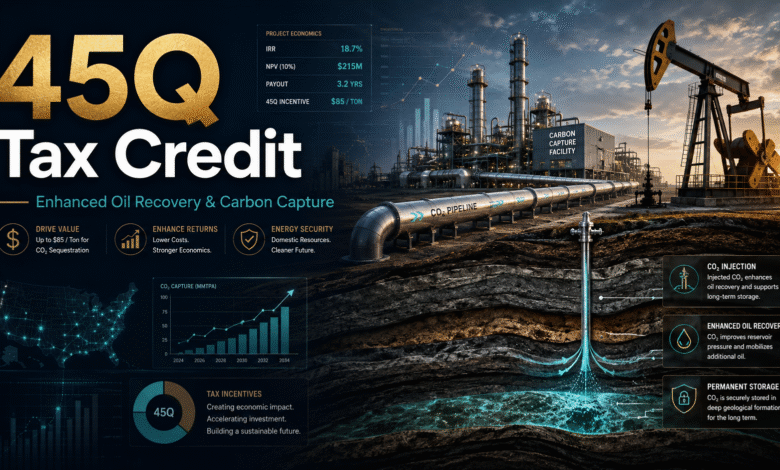
Enhanced oil recovery never had a technology problem. It had a money problem. EOR operators have spent years sitting across the table from investors, watching sequestration-only projects walk away with fatter 45Q tax credit incentives despite doing less with the CO2 they stored. That gap was $25 per metric ton. And it quietly killed more EOR deals than most people in this space care to admit.
That chapter closed on July 4, 2025, when President Trump signed the One Big Beautiful Bill Act into law.
Buried inside the legislation was a revision to Section 45Q that EOR advocates had been pushing for since the IRA first locked in the disparity. The 45Q tax credit for CO2 used in enhanced oil recovery jumped from $60 to $85 per metric ton, matching permanent geological sequestration for the first time. Direct air capture paired with EOR climbed from $130 to $180. A 42% bump on point-source EOR, just like that.
Call it parity. Call it long overdue. Either way, the project economics on the ground look nothing like they did six months ago.
Why The 45Q Tax Credit At $60 Per Ton Was Quietly Killing Deals
Think about it from a developer’s perspective. You have a solid EOR candidate. The reservoir data checks out. There is a CO2 source within pipeline distance. You take the whole package to a tax equity partner, and their model spits out $60 per ton on the 45Q tax credit side. Meanwhile, piping that same CO2 into a saline well gets $85. The meeting wraps up fast, and not in your favor.
EOR projects bring something to the table that saline storage never will, which is incremental oil production. That revenue should tip the math. But the $25 per ton 45Q tax credit gap ate into that advantage. For smaller operators without deep balance sheets, it often erased the edge entirely. Good projects sat on shelves because the policy was making a competing approach artificially cheaper.
Nobody said it that bluntly at industry events. But that is exactly what was happening behind closed doors on the deal side.
What The 45Q Tax Credit At $85 Per Ton Actually Does To The Numbers
Enverus Intelligence Research ran the math shortly after the bill passed, and the results are hard to argue with. The 45Q tax credit increase from $60 to $85 drops conventional EOR production breakevens by more than 40%. We are talking about a shift from roughly $28 per barrel down to somewhere around $16.
Now put that number next to what is left in shale. The best unconventional inventory still available in the Permian sits near $27 per barrel. So conventional EOR, a technique the oil patch has used since the 1970s, now breaks even at nearly half the cost of top-tier tight oil drilling. The 45Q tax credit parity did not just close a gap between two storage methods. It repositioned EOR as one of the cheapest barrels you can find anywhere in the lower 48.
There is an infrastructure angle here that deserves more attention too. Most CO2 pipelines already running in the U.S. feed EOR floods. With 45Q tax credit values now equal, emitters can plug into that existing network instead of waiting years for Class VI injection well permits to clear. Faster deployment, lower upfront risk, same $85 per ton. That combination attracts a very different kind of investor than what EOR projects were pulling in two years ago.
FEOC Restrictions Tighten The 45Q Tax Credit Ownership Rules
The OBBBA did not stop at credit values. It added real teeth on the ownership side as well. New foreign entity of concern rules now block specified foreign entities from claiming or receiving transferred 45Q tax credit benefits, effective immediately. Foreign-influenced entities face the same restriction starting in mid-2027.
What this means in practical terms is that domestic operators and U.S.-controlled developers hold a stronger hand going forward. The structural advantages shaping the 45Q tax credit landscape increasingly favor projects with clean domestic ownership. Foreign capital is not locked out entirely, but the compliance path got noticeably tighter. That matters when you are putting together a credit transfer deal and need every party to pass scrutiny.
The 45Q Tax Credit Transfer Market Opened Up
Here is a ripple effect that has not gotten nearly enough attention. When EOR credits sat at $60 and sequestration credits sat at $85, buyers with tax liability naturally reached for the higher-value asset. EOR credits traded at a structural discount no matter how strong the underlying project was.
Parity wipes that out completely. A 45Q tax credit generated by a well-managed EOR operation now carries the same face value as one from a saline storage project. Buyers can finally evaluate these on what actually matters: CO2 supply reliability, reservoir performance, operator track record. Not just which bucket the CO2 landed in. For EOR developers looking to monetize 45Q tax credit assets through transfer rather than direct use, the pool of willing buyers just got meaningfully bigger.
Conclusion
It would be dishonest to pretend that $85 per ton solves every problem EOR faces. Permitting timelines are still painfully long. CO2 supply logistics remain complicated, especially for projects that need to contract with more than one emitter. And not every depleted reservoir makes a good EOR candidate regardless of what the credit pays.
But the 45Q tax credit at $85 per ton removes the one barrier that was entirely a policy problem and entirely within reach of a legislative fix. Projects that were marginal at $60 now pencil out. 45Q tax credit buyers who passed on EOR assets have a real reason to come back to the table. And CO2 pipeline operators who built infrastructure years ago just got confirmation that their assets are worth more than the market was giving them credit for.
The gap is gone. The math works. What happens next depends on who moves first.