Picture this: it’s Monday in 2029 and half of your “untouchable” cold-storage Bitcoin addresses read zero. No malware, no rogue employee—just a quantum computer that flipped public keys into private keys in minutes. Google treats 2029 as the deadline for full post-quantum defenses, and attackers are already stockpiling today’s encrypted traffic, certain they’ll crack it later.
We’ve mapped the risk layer by layer and vetted tools you can pilot this quarter. In the next few minutes you’ll learn what to upgrade first, which vendors deserve a demo, and how to keep regulators (and auditors) calm while you migrate.
Grab a coffee—let’s future-proof your stack.
Why digital-asset infrastructure feels the quantum heat first
Blockchains are built to last. Every public key you broadcast, every signature you post, sits forever in a ledger anyone can download. That permanence boosts transparency, yet it also hands attackers an unlimited rehearsal window.
Traditional enterprises can rotate keys quietly behind a firewall. You and I can’t rewrite history on Bitcoin or Ethereum. If someone records today’s ECDSA signature, a future quantum computer could derive the private key and sweep funds without touching network consensus—no alarms, no rollback.
The blast radius is wider than wallets. Custody providers run multi-party computation, exchanges move assets across data centers, and validators sign blocks at machine speed. Each layer relies on elliptic-curve math that assumes Shor’s algorithm stays theoretical.
Regulators have noticed. In 2025 the FFIEC asked supervised banks to inventory their cryptography within 12 months, and the European Central Bank issued similar guidance two quarters later. Investors now view quantum readiness as table stakes, not a bonus feature.
In short, digital-asset stacks can’t hide behind annual patch cycles. We need targeted, layer-specific defenses before the qubits catch up.
How we vetted quantum-safe solutions
Choosing vendors for a crypto migration can feel like speed-dating at a cryptography conference. Everyone claims NIST compliance, zero performance drag, and military-grade magic. We cut through the noise with a scoring model shaped by real-world constraints for exchanges and custodians.
We started with 41 vendors in January 2026 and kept only those that shipped a product you can pilot today and that relies on NIST-selected algorithms. Proof-of-concept papers and retired candidates (sorry, SIKE) never made it past the door.
Each remaining solution was graded across six dimensions:
- Cryptographic strength and standards alignment
- Integration scope and ease: can you drop it into wallets, HSMs, or APIs without rewiring your stack?
- Performance overhead: latency, transaction size, and bandwidth—measured, not promised.
- Security assurance and compliance: audits, FIPS 140-3 roadmaps, participation in NIST or ETSI test events.
- Market traction: live deployments, funding, or regulator pilots that signal durability.
- Differentiation: does it cover a new layer of the stack or repeat what another vendor already handles better?
We weighted those factors in that order. Strength and integration mattered most because an unbreakable algorithm still fails you if it ties up six months of engineering time.
The list stays unranked. A network gateway and a Layer-1 blockchain solve different problems, so we align each pick with the layer you would tackle on a practical migration roadmap—starting at the private key and working outward.
That yardstick guides every solution that follows.
Layer 1 – keys and wallets: Project 11
Your private key is the crown jewel of any crypto stack, so we start where risk begins. Project 11 rewires key generation by replacing ECDSA with Dilithium and Kyber while keeping everyday wallet workflows intact.
You create an address as usual, deposit Bitcoin, and the chain still sees a valid public key. Behind the scenes, the key pair lives in a dual-mode format: classical for today’s nodes, lattice-based for tomorrow’s quantum crunchers. Exchanges integrate through a lightweight SDK that relies on the same JSON-RPC calls their wallet services already use, so rollout feels like a configuration change, not a rewrite. For larger operations that need a full migration blueprint—protocol reviews, threat-modelling, and staged key rotation—Project 11’s enterprise team offers a suite of post-quantum cryptography solutions refined while auditing live blockchain networks. That guidance turns a swift SDK drop-in into a whole-stack risk-reduction programme.
Why do we like it? The team fixes blockchain-specific pain points instead of shipping a generic TLS library, and early pilots show signing latency remains in the single-millisecond range—fast enough that traders never notice. The code base is open source, and in March 2026 the company closed a 26-million-dollar Series A that should fund version two.
Caveats remain. Mainnet use is limited to controlled pilots, and larger signature payloads will nudge transaction fees upward once adoption spreads. Still, if you need a proof of concept that shields coins without forcing a Bitcoin fork, Project 11 is the most direct option we have tested.
Layer 2 – custody vaults: Silence Laboratories
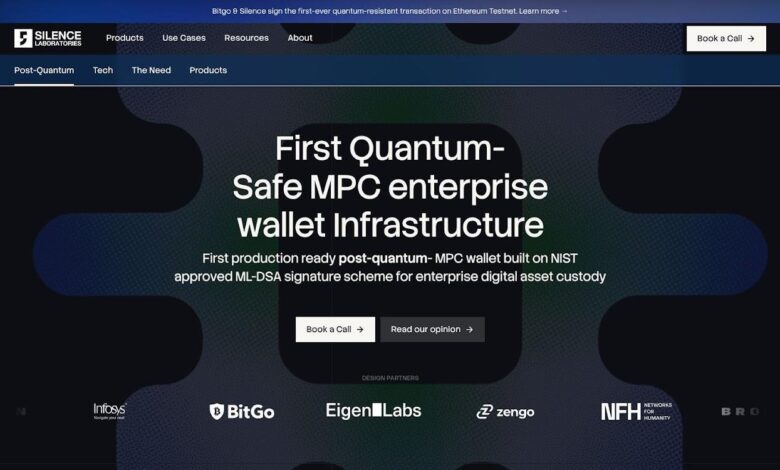
Once your keys are quantum-tough, the next concern is how those keys are shared and signed in production. Most institutional custodians rely on multi-party computation because it removes any single point of failure. Silence Laboratories keeps that model intact but replaces the classical math with ML-DSA, the NIST-standard flavour of Dilithium.
The newly released quantum-safe vault connects to the same signing flow your operations team already trusts. Each participant still signs their shard, yet the combined signature resists Shor’s algorithm. Integration happens at the HSM or enclave layer, so front-end systems barely notice the swap.
In pilot data shared at the April 2026 launch, end-to-end signing time rose by about ten percent, a negligible hit for cold-storage routines. More important, the product allows a phased migration: ECDSA accounts and PQ accounts can run side by side while clients move at their own pace.
Silence Laboratories is young, but merging MPC with post-quantum signatures in a ready-to-deploy product drew quick attention. Longer-term audits are still pending, yet if your board wants a quantum-ready custody demo this quarter, the vault belongs on your shortlist.
Layer 3 – protocol DNA: Algorand
Upgrading wallets and vaults helps, yet every transaction still rides a public chain that signs blocks with legacy math. Algorand replaced that math at the protocol layer.
In 2022 the team embedded Falcon, a lattice-based signature scheme now endorsed by NIST, into State Proofs to secure the chain’s history. By November 2025 they sent the first mainnet transaction signed with Falcon, proving a quantum-safe transfer can move through thousands of nodes without disruption.
For builders, the path is clear. Rekey existing accounts to Falcon-based authorizers and the chain’s signature layer shields your assets from future key extraction. No dual certificates, no hybrid handshakes; native account abstraction does the work.
Performance was the early concern. Falcon signatures are about 1.6 kilobytes—roughly four times Ed25519—yet Algorand’s testing shows no drop in throughput or finality. Compact encoding and fast verification keep blocks finalising in under five seconds.
The trade-off is scope. You must operate on Algorand to gain the benefit. Migrating an Ethereum DeFi app is complex, and Bitcoin holders are unlikely to switch chains for quantum safety alone. Still, if you plan to launch new assets or a regulated tokenisation project with a ten-year horizon, choosing a chain that is quantum-ready by default avoids a future migration.
Layer 4 – hardware roots of trust: PQShield
Software fixes carry you only so far; sooner or later the cryptography has to live on silicon. PQShield addresses that need by licensing chip-level IP blocks that run Kyber, Dilithium, and SPHINCS+ inside secure elements, smart cards, and data-centre HSMs.
Imagine a hardware wallet maker inserting a PQShield core into its microcontroller and generating lattice keys in constant time, safe from side-channel attacks. Banks planning a 2027 HSM refresh gain similar benefits at rack scale, with firmware that exposes the new algorithms alongside RSA and ECDSA. There is no risky emulation layer and no CPU-intensive big-integer library.
Speed holds up. Internal tests published in February 2026 show Dilithium signing in 3.4 milliseconds and Kyber key exchange in 2.1 milliseconds. Because the logic is fixed in silicon, power draw falls by roughly 18 percent compared with software libraries, a practical win for mobile and IoT devices that store on-chain credentials.
There is, however, a timing trade-off. Hardware cycles move slower than software, so you need to specify PQ-ready chips in your next procurement plan; retrofitting last year’s wallet is not realistic. Major vendors such as NXP and Microchip have already taped out PQShield cores, so aligning the 2027 hardware budget with those parts positions you ahead of the qubit curve. When quantum computers mature, protection will sit at the transistor level rather than relying on a last-minute patch.
Layer 5 – data in transit: QuSecure
Quantum thieves can ignore your keys if they can replay every encrypted API call your systems ever sent. QuSecure’s QuProtect gateway blocks that threat by turning TLS and VPN handshakes into hybrid post-quantum sessions.
Deploy it like a firewall. Route outbound and inter-data-centre traffic through the appliance; it negotiates keys with both elliptic-curve exchange and Kyber. If a powerful quantum computer appears tomorrow, packets captured today remain unreadable.
Setup stays simple. Spin up the virtual machine, point load balancers at its address, and QuSecure’s console shows which flows are now quantum safe. Only the handshake changes: March 2026 benchmarks record an extra 7 milliseconds on session setup, while bulk data still runs at line speed.
Fast payback is the draw. Thousands of microservices gain protection without code changes. Keep in mind that a gateway shields moving data, not the keys or the ledger behind it.
When auditors ask whether you are mitigating harvest-now-decrypt-later risk today, QuSecure lets you answer yes before the next trading window opens.
Layer 6 – enterprise-wide crypto agility: SandboxAQ
Post-quantum upgrades rarely live in a single repository. They sprawl across mobile apps, trading engines, mainframes, and forgotten cron jobs. Since its public launch in February 2025, SandboxAQ has turned that sprawl into an ordered inventory and then automated replacements at scale.
The process begins with discovery. The scanner crawls binaries and configuration files, flags every RSA or secp256k1 reference, and maps the data flows that rely on them. Dashboards turn the findings into an actionable punch list your engineers can ship against.
Policy comes next. You select approved algorithms such as Kyber for key exchange and Dilithium for signatures. SandboxAQ’s agent delivers the libraries through CI pipelines or direct server pushes. Existing endpoints continue in hybrid mode, so user-facing services stay online during the transition.
Governance is the differentiator. Auditors value snapshots that show, for example, “92 percent of production traffic now uses PQC,” and regulators increasingly ask for that proof. Treating cryptography as a managed asset helps large exchanges avoid the surprise of an unpatched microservice later.
Cost and complexity rise with footprint, so the platform fits organisations that operate across teams and continents. A lean DeFi startup may rely on open-source libraries, but a Fortune 50 bank launching a digital-asset desk gains scale and assurance from automated crypto agility.
Layer 7 – secure comms and VPN: Post-Quantum (UK)
Even the best wallet is useless if staff exchange seed phrases over channels that future attackers can replay. London-based Post-Quantum closes that gap with a VPN and messaging suite protected by lattice cryptography.
Deploy the VPN server on standard hardware, roll out lightweight clients, and traffic between offices or validator nodes gains a Kyber-backed key exchange. Tests run with the NATO Cyber Security Centre in July 2025 moved classified data with a 4.6 percent throughput loss, showing that security and speed can coexist.
The platform’s range is its edge. Beyond tunnels, Post-Quantum offers secure voice and chat. Compliance teams use it for incident discussions, confident that transcripts remain confidential even if intercepted and stored for years.
Pedigree matters. The company has spent more than a decade in defence circles, contributed algorithms to the original NIST competition, and field-tested software with the UK National Cyber Security Centre. That record of government vetting is rare in the vendor landscape.
For crypto firms, the product closes a final gap: conversations, support tickets, and hot-wallet scripts now travel under quantum-safe cover. It will not sign a blockchain block, but it will keep your incident channel out of tomorrow’s breach report.
Conclusion: Stacking the options side by side
We have covered the stack from private keys to coffee-break chats. Before you choose pilot partners, it helps to see how each solution lines up on the metrics that matter: algorithms, integration effort, speed, and proof.
The grid below distills those details. Use it as a cheat sheet when stakeholders ask, “Which box fixes which risk, and what is the trade-off?”
| Layer protected | Solution | Core algorithms | Integration lift | Reported overhead | Proof points | Watch-out |
| Keys & wallets | Project 11 | Dilithium, Kyber (dual mode) | Swap wallet SDK | ≈ +1 ms per sign | Open-source library, 26-million-dollar Series A | Larger signatures raise transaction fees |
| Custody MPC | Silence Labs | Dilithium (ML-DSA) inside MPC | Drop-in vault module | ≈ ten percent slower signing | NIST-aligned, April 2026 launch | Early-stage audits |
| Protocol | Algorand | Falcon in State Proofs | Rekey to Falcon accounts | None reported on mainnet | Live Falcon transaction Nov 2025 | Chain lock-in |
| Hardware | PQShield | Kyber, Dilithium, SPHINCS+ cores | New chips or HSMs | Hardware level, near zero | Smart-card tape-outs, FIPS roadmap | Requires hardware refresh |
| Network | QuSecure | Hybrid TLS (Kyber + ECC) | Deploy VM or appliance | + few ms handshake | US-government pilots | Gateway can become a single choke point |
| Crypto agility | SandboxAQ | Kyber, Dilithium library plus orchestration | Organisation-wide agent rollout | Varies by service | Fortune 50 bank deployments | Enterprise cost |
| Comms VPN | Post-Quantum | Kyber VPN and lattice chat | Install server and client | < five percent throughput loss | UK NCSC field tests | Only protects comms |
Read the table from top to bottom as a phased roadmap: secure keys first, then scale outward. The Watch-out column highlights where pilots often stumble, useful for risk registers and sprint planning.