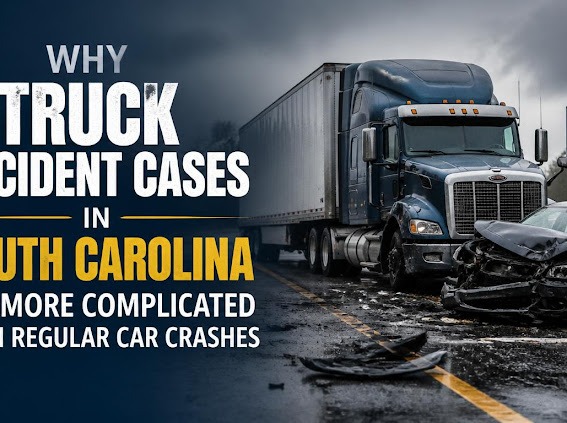
Truck accidents in South Carolina are among the most devastating collisions on South Carolina roads. While any motor vehicle crash can leave victims with serious injuries and financial losses, truck accident cases are often far more complicated than standard car accident claims. What may appear to be a straightforward collision can quickly turn into a legal battle involving multiple parties, federal regulations, extensive evidence, and aggressive insurance defense teams.
For victims and their families, understanding why truck accident cases are different is essential. The complexity of these cases often affects how liability is determined, how evidence is gathered, and how compensation is pursued. In South Carolina, truck accident claims require a much deeper investigation than the average passenger vehicle collision.
The Size and Severity of SC Truck Accidents Create Higher Stakes
One of the most obvious differences between truck accidents and ordinary car crashes is the sheer size of the vehicles involved. A fully loaded commercial tractor-trailer can weigh up to 80,000 pounds, while a passenger vehicle typically weighs between 3,000 and 5,000 pounds.
Because of this enormous weight difference, truck accidents often result in:
- Catastrophic injuries
- Permanent disabilities
- Traumatic brain injuries
- Spinal cord damage
- Multiple surgeries
- Long-term rehabilitation
- Fatalities
The severity of these injuries significantly increases the value of potential claims. Higher-value claims naturally attract more resistance from insurance companies and trucking companies seeking to minimize their financial exposure. As a result, truck accident litigation tends to be much more aggressive than ordinary car accident cases.
Multiple Parties May Be Responsible in Any South Carolina Semi Crash
In a typical car accident, determining liability often involves identifying which driver caused the crash. Truck accident cases are rarely that simple.
A commercial trucking operation involves numerous individuals and entities that may contribute to an accident. Potentially liable parties may include:
- The truck driver
- The trucking company
- The owner of the truck
- A cargo loading company
- Maintenance contractors
- Repair facilities
- Parts manufacturers
- Vehicle manufacturers
- Government entities responsible for road maintenance
For example, a truck driver may have lost control because of brake failure. An investigation could reveal that a maintenance company failed to inspect the brakes properly or that a manufacturer produced a defective component.
Determining who is responsible often requires extensive investigation and expert analysis. In many cases, liability is shared among several parties rather than resting solely with the truck driver.
Federal Regulations Add Another Layer of Complexity in SC Commercial Truck Collisions
Most passenger vehicle accidents are governed primarily by South Carolina traffic laws. Trucking companies, however, must also comply with extensive federal regulations.
Commercial trucking operations are heavily regulated by the Federal Motor Carrier Safety Administration (FMCSA). These regulations cover:
- Driver qualifications
- Hours-of-service requirements
- Vehicle inspections
- Maintenance schedules
- Drug and alcohol testing
- Cargo securement
- Driver training
- Recordkeeping requirements
When a trucking company or driver violates these regulations, those violations may serve as evidence of negligence in a civil claim.
For instance, if a driver exceeds allowable driving hours and falls asleep behind the wheel, the violation may become a critical piece of evidence showing fault. Investigators frequently examine FMCSA compliance records when evaluating truck accident claims.
Driver Fatigue Is a Major Concern in Commercial Truck Crashes in SC
Driver fatigue plays a much larger role in truck accidents than in ordinary car crashes.
Commercial truck drivers often spend long hours behind the wheel. While federal and state regulations establish limits on driving time, violations still occur.
In South Carolina, intrastate trucking operations are subject to hours-of-service requirements that limit driving and duty hours. Investigators may examine:
- Driver logbooks
- Electronic logging devices (ELDs)
- GPS records
- Fuel receipts
- Dispatch records
These documents help determine whether a driver exceeded legal driving limits or was operating while fatigued.
Unlike a standard car accident investigation, proving fatigue often requires reviewing thousands of pages of records and analyzing electronic data.
SC Truck Accident Evidence Is More Extensive
Evidence collection in truck accident cases is significantly more complicated than in passenger vehicle accidents.
A typical car accident case may rely on:
- Police reports
- Witness statements
- Vehicle photographs
- Medical records
Truck accident cases often involve all of the above plus specialized evidence such as:
- Black box data
- Event data recorder information
- Electronic logging device records
- Maintenance logs
- Inspection reports
- Driver qualification files
- Employment records
- Drug testing results
- Dispatch communications
- Cargo manifests
- Surveillance footage
Much of this evidence is controlled by the trucking company. As a result, attorneys frequently act quickly to preserve evidence before it can be lost, altered, or destroyed.
Black Box Technology Provides Critical Information in the Event of SC Truck Crashes
Most commercial trucks contain event data recorders, commonly known as “black boxes.”
These devices can record valuable information such as:
- Vehicle speed
- Braking activity
- Steering inputs
- Engine performance
- Hours of operation
- Sudden acceleration or deceleration
This data can help reconstruct the events leading up to a crash.
Obtaining and analyzing black box information often requires specialized experts and legal procedures. Unlike a typical car accident, where evidence may be limited to witness accounts, truck accident investigations frequently rely on highly technical electronic evidence.
SC Trucking Companies Often Deploy Rapid Response Teams
One reason truck accident cases become complicated so quickly is that trucking companies often begin investigating immediately after a serious collision.
Large carriers may send rapid response teams to accident scenes within hours. These teams can include:
- Defense attorneys
- Insurance investigators
- Accident reconstruction experts
- Company safety personnel
Their primary objective is protecting the trucking company from liability.
Meanwhile, injured victims are often receiving emergency medical treatment and may be unaware that an extensive defense investigation is already underway. This imbalance can make preserving evidence and establishing fault more difficult for victims.
Insurance Coverage Is More Complex
Insurance issues are often far more complicated in truck accident cases than in ordinary vehicle collisions.
A standard passenger vehicle policy may provide relatively modest coverage limits. Commercial trucking policies frequently involve substantially larger coverage amounts.
Federal regulations generally require many commercial carriers to maintain significant liability insurance coverage, often starting at $750,000 and potentially extending into the millions of dollars depending on the operation.
Additionally, multiple insurance policies may apply, including:
- Driver insurance
- Motor carrier insurance
- Trailer insurance
- Excess liability coverage
- Umbrella policies
Determining which policies apply and how coverage is allocated can become a major legal issue.
Accident Reconstruction Is More Technical with SC Semi Collisions
Truck accident reconstruction is often much more complicated than reconstructing a passenger vehicle collision.
Investigators must evaluate factors such as:
- Cargo weight
- Cargo distribution
- Braking distances
- Vehicle stability
- Road grade
- Tire conditions
- Mechanical failures
- Electronic data
Commercial trucks behave very differently from passenger vehicles due to their size and weight. Accident reconstruction experts frequently use advanced software, engineering principles, and data analysis to determine how a collision occurred.
This level of technical investigation is often unnecessary in a routine car accident case.
Cargo Loading Can Create Liability
Improperly loaded cargo is a unique factor that rarely exists in passenger vehicle accidents.
Cargo problems can cause:
- Jackknife accidents
- Rollovers
- Cargo spills
- Loss of vehicle control
In some cases, the truck driver may not have loaded the cargo at all. Instead, a separate shipping company or loading contractor may have performed that task.
If improperly secured cargo contributes to a crash, liability may extend beyond the trucking company and driver. This creates additional legal and evidentiary challenges.
Mechanical Failures Require Specialized Investigation
Mechanical defects frequently play a role in truck accidents.
Potential issues include:
- Brake failures
- Tire blowouts
- Steering defects
- Lighting malfunctions
- Coupling failures
When mechanical problems contribute to a collision, investigators must determine:
- Whether maintenance was neglected
- Whether inspections were properly performed
- Whether a defective part caused the failure
This process often requires engineers, mechanics, and industry experts who can evaluate the vehicle’s condition and maintenance history.
Comparative Negligence Can Complicate Recovery
South Carolina follows a modified comparative negligence system.
Under this system, an injured party may recover compensation if they are not more than 50 percent responsible for the accident. However, any compensation awarded is reduced by the victim’s percentage of fault. If a person is found 51 percent or more responsible, recovery is generally barred.
In truck accident cases, defendants frequently argue that the injured motorist contributed to the collision by:
- Following too closely
- Speeding
- Failing to yield
- Driving distracted
- Making unsafe lane changes
Because multiple parties may share fault, determining percentages of responsibility often becomes a major point of dispute.
Severe Damages Require Extensive Documentation
Truck accident injuries are often life-changing.
As a result, damage calculations may include:
- Past medical expenses
- Future medical care
- Lost wages
- Reduced earning capacity
- Rehabilitation costs
- Home modifications
- Long-term nursing care
- Pain and suffering
- Loss of enjoyment of life
Proving these damages often requires testimony from:
- Physicians
- Economists
- Vocational experts
- Life-care planners
The need for expert witnesses adds another layer of complexity not commonly found in routine car accident cases.
Truck Accident Cases Often Involve Wrongful Death Claims
Because commercial trucks can cause devastating collisions, fatal accidents occur more frequently than in many ordinary passenger vehicle crashes.
When a fatality occurs, surviving family members may pursue a wrongful death claim in addition to other legal remedies.
Wrongful death cases involve unique legal requirements, additional damages calculations, and complex procedural rules. Families must often prove not only negligence but also the financial and emotional impact of the loss.
Time-Sensitive Evidence Makes Early Action Critical
One of the biggest challenges in truck accident litigation is preserving evidence before it disappears.
Electronic data may be overwritten. Records may be lost. Witness memories can fade.
For this reason, truck accident investigations often begin immediately after a collision. Attorneys frequently send preservation notices requesting that trucking companies retain critical evidence such as:
- Driver logs
- Maintenance records
- Black box data
- Inspection reports
- Internal communications
Acting quickly can make a substantial difference in the strength of a claim.
South Carolina’s Growing Truck Traffic Adds More Risks
South Carolina’s highways experience heavy commercial truck traffic every day. Major trucking routes such as Interstate 26, Interstate 77, and Interstate 95 serve as vital transportation corridors for freight moving throughout the Southeast.
With increased commercial activity comes increased risk. Congested highways, long-haul trucking schedules, and high delivery demands can all contribute to dangerous driving conditions.
Busy trucking corridors often see accidents involving:
- Rear-end collisions
- Wide-turn accidents
- Jackknife crashes
- Underride accidents
- Blind spot collisions
- Tire blowouts
The combination of large commercial vehicles and crowded roadways creates a unique set of dangers that are far different from ordinary passenger vehicle traffic accidents.
Trucking Companies Often Have Strong Legal Defense Teams
Another reason truck accident cases are more difficult is the level of legal resistance victims often face.
Large trucking companies and commercial insurers frequently work with experienced defense attorneys whose primary goal is reducing liability and limiting payouts. These defense teams may challenge:
- The severity of injuries
- Medical treatment costs
- Liability findings
- Accident reconstruction conclusions
- Witness credibility
In some cases, trucking companies may even attempt to shift blame to injured motorists.
This aggressive defense strategy is far more common in truck accident litigation than in ordinary car crash claims because the financial stakes are often significantly higher.
Medical Treatment in Truck Accident Cases Is Often Long-Term
Victims of truck accidents frequently require extensive medical treatment that continues for months or years after the crash.
Common long-term treatments may include:
- Physical therapy
- Occupational therapy
- Multiple surgeries
- Pain management
- Psychological counseling
- Mobility assistance
- Rehabilitation programs
The long-term nature of these injuries makes calculating damages more difficult. Doctors and medical experts may need to estimate future treatment needs, ongoing care expenses, and permanent disabilities.
These future damages can become a major point of disagreement during settlement negotiations or litigation.
Emotional Trauma Can Be Significant
Truck accidents often leave lasting emotional and psychological effects in addition to physical injuries.
Victims may experience:
- Anxiety
- Depression
- Post-traumatic stress disorder (PTSD)
- Sleep disturbances
- Fear of driving
- Emotional distress
The violent nature of many truck crashes can make emotional trauma particularly severe. Mental health treatment and counseling may become part of the damages claimed in a lawsuit.
Unlike minor fender-benders, truck accidents can permanently affect a person’s quality of life and emotional well-being.