Your Ears Do Not Get a Second Chance Why Occupational Noise Assessment Matters More Than You Think

Every single day, workers across Australia walk into noisy environments and get on with their jobs. Factories, construction sites, mining operations, manufacturing plants — the noise is constant, relentless, and in many cases, dangerously loud. Most workers accept it as part of the job. Most employers assume that handing out earplugs is enough. But the reality is far more serious than either of them realises.
Noise-induced hearing loss is permanent. There is no cure, no surgery, and no medication that can restore hearing once it has been damaged by excessive noise exposure. And unlike a broken bone or a visible cut, the damage builds silently and gradually often over years before the worker even notices something is wrong. By then, the damage is already done.
This is exactly why occupational noise assessment is one of the most critical tools in any workplace safety program. Not just for compliance. Not just for paperwork. But because your workers’ ears genuinely do not get a second chance.
What Is an Occupational Noise Assessment?
An occupational noise assessment is a formal process of measuring and evaluating the noise levels workers are exposed to in their workplace. It identifies where noise hazards exist, which workers are at risk, how significant that risk is, and what steps need to be taken to reduce or eliminate it.
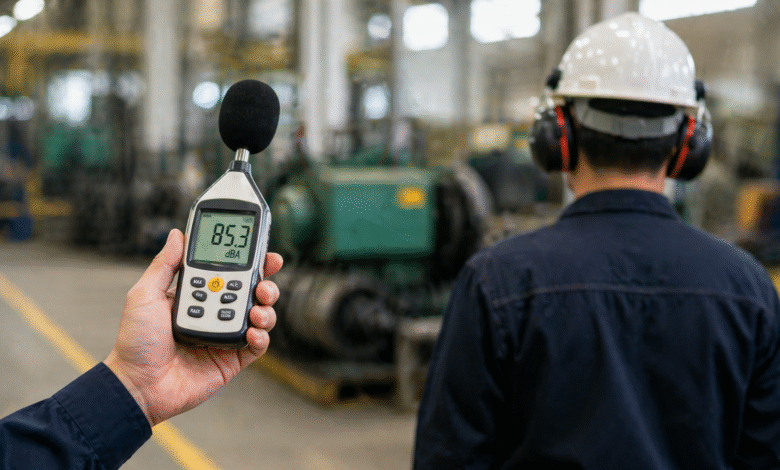
The assessment involves using calibrated sound level meters and noise dosimeters to measure noise across different areas of the workplace and across different tasks throughout the working day. The results are then compared against the exposure standards set under Australian Work Health and Safety (WHS) legislation — which sets the permissible noise exposure limit at 85 decibels averaged over an eight-hour working day, with a peak noise limit of 140 decibels.
If those limits are being exceeded — or even approached — action is required. And the only way to know for certain is through a proper, professionally conducted occupational noise assessment.
Why Is It So Important?
Many employers underestimate the risk of noise in their workplace. They assume that because workers have been doing the same job for years without obvious complaints, everything must be fine. But that assumption is dangerous for several reasons.
First, noise-induced hearing loss is cumulative. Each day of unprotected exposure adds to the total damage. A worker might be exposed to hazardous noise levels for five, ten, or fifteen years before they notice any significant change in their hearing. By that point, the loss is already permanent and irreversible.
Second, workers often adapt to loud environments without realising the harm being done. Tinnitus — the persistent ringing or buzzing in the ears that is one of the earliest signs of noise-induced hearing loss — is frequently dismissed as normal. It is not normal. It is a warning sign that damage is occurring.
Third, the legal consequences of failing to manage workplace noise are significant. Under WHS legislation, employers are required to manage noise risks so far as is reasonably practicable. This means identifying the hazard, assessing the risk, and implementing controls. Without a formal occupational noise assessment on record, an employer has no evidence that they have met this obligation — and no defence if a worker makes a compensation claim.
Who Needs an Occupational Noise Assessment?
The short answer is: any workplace where noise could reasonably be considered a risk. That covers a much wider range of industries and environments than most people assume.
Construction and demolition sites are obvious candidates — the noise from heavy machinery, power tools, compressors, and impact work is well-documented. But occupational noise assessment is equally important in manufacturing facilities, food processing plants, printing operations, transport depots, agricultural settings, entertainment venues, and even some office environments where noise from open-plan layouts or equipment creates chronic low-level exposure.
The key is not to assume. Noise levels that feel tolerable to the human ear can still exceed safe exposure limits over the course of a working day. The only way to know for certain is to measure them properly.
What Happens During an Assessment?
A professional occupational noise assessment typically involves several stages. First, a walkthrough of the workplace is conducted to identify noise sources and understand the work patterns and routines of different employees. Then, measurements are taken using calibrated equipment — both area measurements to map noise levels across the site and personal dosimetry measurements worn by workers to capture their actual daily exposure.
The results are then analysed and presented in a detailed report. This report identifies which areas and roles exceed the exposure standard, outlines the risk level for each, and provides clear, practical recommendations for noise controls. These controls follow the hierarchy of controls — starting with elimination or substitution of the noise source where possible, moving through engineering controls such as acoustic enclosures or barriers, and then administrative controls and PPE as supporting measures.
Working with experienced workplace health and safety specialists ensures that the assessment is thorough, compliant, and genuinely useful — not just a box-ticking exercise but a practical tool that drives real improvement in worker protection.
The Cost of Doing Nothing
Some employers still see occupational noise assessment as an optional extra — something to get around to eventually. But the cost of inaction is far greater than the cost of the assessment itself.
Workers’ compensation claims for noise-induced hearing loss are among the most common occupational disease claims in Australia. They are also among the most preventable. When an employer cannot demonstrate that they identified and managed noise risks in their workplace, they face not only financial liability but potential regulatory prosecution and lasting reputational damage.
More importantly, there is a human cost that no amount of compensation can address. A worker who loses their hearing loses far more than just their ability to do their job. They lose the ability to hear conversations clearly, to enjoy music, to hear their family — things that most people take entirely for granted until they are gone.
Take Action Before It Is Too Late
Noise-induced hearing loss is irreversible. But it is also, in the vast majority of cases, entirely preventable — provided the right steps are taken at the right time. Understanding the noise risks in your workplace and putting in place the right controls is what separates responsible employers from reactive ones.
Do not wait for a complaint, a claim, or a tragedy to force your hand. Get a proper assessment done, implement the right controls, and protect your workers before the damage is done. If you are looking for workplace health and safety specialists who can guide you through the entire process, make sure you work with a team that brings both scientific expertise and practical experience to every assessment.