In the wave of digital manufacturing how can we avoid a 40% efficiency loss due to insufficient precision of helical gears

Introduction
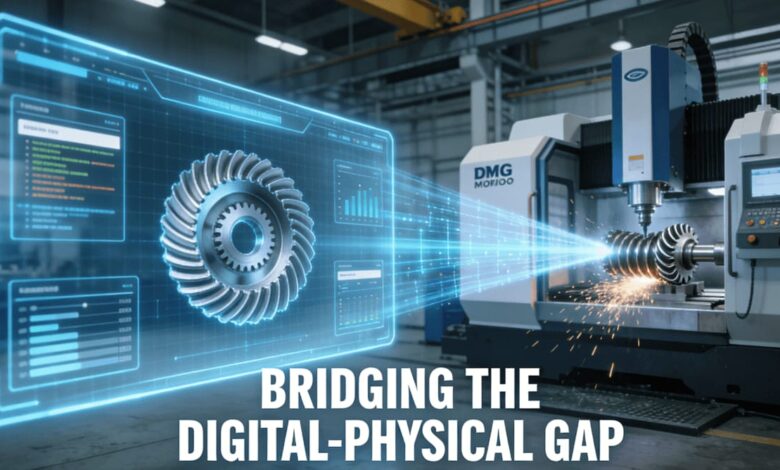
While digital platforms optimize manufacturing, the “last mile” of physical precision, especially for complex parts like helical gears, remains a bottleneck. The precision of this process is of vital importance. The traditional methods are often not as consistent or as precise as required, even down to micrometers, and this results in vibrations and a reduced lifespan of equipment. The integration of Precision Manufacturing Technology, such as helical gear milling, is essential in this regard.
Why is Precision Manufacturing Technology the Physical Cornerstone for Digital Manufacturing Platform Implementation?
Digital manufacturing platforms, like digital twins and MES, optimize data flow, but their value depends entirely on the quality of the physical data they receive. Inconsistency in the production of physical components leads to a situation of “garbage in, garbage out.” This is where Precision Manufacturing Technology plays a pivotal role as the bridge that ensures the replication of virtual instructions in the physical domain.
For example, minor deviations in a helical gear’s tooth profile, potentially masked in a digital twin, cause real-world vibration and failure. The integrity of the entire “digital thread” relies on the traceable quality of each physical manufacturing step. Therefore, precision manufacturing is not isolated; it is the essential physical enabler that allows digital platforms to deliver real value, with the manufacturing quality of core components like helical gear machining serving as the true test of this fusion.
Among Various Gear Types, Why are the Precision Requirements for Helical Gear Milling Particularly Stringent?
Compared to spur gears, helical gears offer significant advantages such as smoother transmission, lower noise, and higher load capacity due to their helical tooth profile. However, these very advantages introduce high manufacturing complexity, placing stringent precision demands on the Helical Gear Milling process.
The Correlation Between Gear Types and Performance
Among common types of gear cutting, spur gears have teeth parallel to the axis, making their machining relatively straightforward. Double helical gear (herringbone gear) can cancel axial forces but has a more complex structure. Helical gears, however, require precise control of the helix angle on a single helical tooth to achieve smooth load transition. This design advantage directly translates into rigorous requirements for tooth profile consistency, helix angle accuracy, and surface finish.
The Machining Challenge of the Involute Helical Surface
The tooth flank of a helical gear is a complex involute helical surface. This means that during the process of milling, the point of contact between the tool and the work piece is in a constant state of change in three-dimensional space. The process of gear cutting on a milling machine is, therefore, required to utilize its ability for simultaneous motion of at least four axes in order to “sculpt” this curve in three-dimensional space. Any discrepancy in the relative motion of the axes will directly lead to errors in the profile of the teeth.
The Chain Reaction of Precision Loss
Precision errors in helical gears can trigger a series of chain problems.
- Deterioration of Transmission Quality:
Tooth alignment errors can lead to poor gear meshing, causing vibration and noise, rendering the actual performance poor even if digital simulation shows smooth operation. - Attenuation of System Lifespan:
Uneven load distribution significantly accelerates failure modes like pitting and wear, completely invalidating equipment lifespan predictions based on digital models.
To deeply address these challenges, mastering best practices in helical gear machining is crucial. One can refer to this professional guide: helical gear machining.
The Core of Achieving High-Precision Helical Gears: What are the Secrets in Machine Tool Technology and Tool Selection?
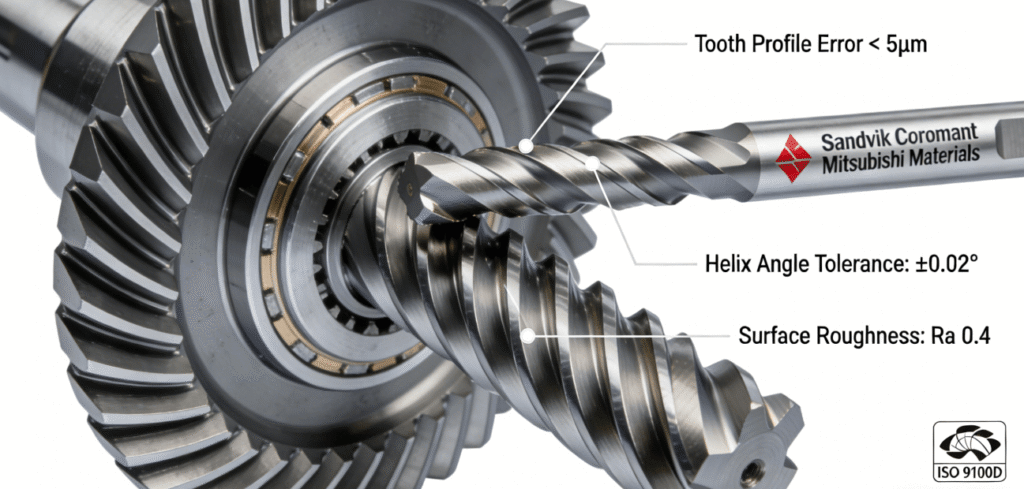
To successfully produce micron, level precision helical gears, one has to methodically integrate the machines, the processes, and the tools. An advanced gear, cutting machine made from a high, performance platform is a key factor in the combination that normally requires the machine to have a very rigid structure to avoid the formation of vibrations, a good thermal stability to offer the same level of precision and a CNC system that is capable of providing a control at a nano level of the gear, cutting process. On the other hand, the cutting tool plays an equally, if not more, important role. The material of the cutting tools, like ultra, fine grain carbide or CBN.
Cuts resistance; advanced coating that reduce friction; and the exact geometry which ensures good cutting. The whole operation is basically the mill throwing around some carefully worked out parameters for the right mix of productivity and precision. Giving in to the different standards, that is to say, ASME those for the performance of the tool, deeply rooting it in the nature of things, the process is self, stable and the production of very precise gears is reliable.
Sourcing Gear Cutting Services: Choosing Between a Local Supplier or a Global Precision Manufacturing Partner?
When a project requires custom gear machining, companies often face a choice: search for “gear cutting near me” to find a local supplier or collaborate with a precision manufacturing partner with global delivery capabilities.
Evaluating the Pros and Cons of Local Suppliers
The advantages of choosing a local service lie in convenient communication, quick response times, and simple logistics, making them particularly suitable for urgent prototypes or small-batch modifications. However, their limitations are also quite evident: technical capabilities and equipment levels may be constrained by the local industrial ecosystem, making it difficult to handle high-complexity, high-precision challenges; the range of available materials and processes may be narrower; and during periods of capacity crunch, supply chain resilience can be relatively fragile.
The Value and Systemic Capability of a Global Precision Manufacturing Partner
Collaborating with a professional global custom gear machining service provider offers value that transcends geographical limitations. Its core advantages are reflected in two key areas:
- Extensive Technical Resources and Engineering Support
Such partners typically possess more advanced equipment clusters and richer material libraries, enabling them to provide full-process engineering support for challenging projects, from design optimization to prototype manufacturing. Leveraging their economies of scale and specialized processes, they can often achieve more competitive costs while ensuring higher precision.
- Global Consistency Guaranteed by Certification Systems
Modern quality management systems and logistics networks effectively bridge geographical distances. Suppliers certified to stringent standards like IATF 16949 (automotive) and AS9100D (aerospace), such as JS Precision, ensure that products delivered from any manufacturing facility maintain globally consistent high standards through fully standardized, traceable quality control processes. This cooperation, based on systemic trust, offers reliability far exceeding mere geographical proximity.
How to Verify if Your Helical Gear Supplier Possesses Reliable Precision Manufacturing Capability?
Determining the suitability of a helical gear supplier should be more thorough than just finding out whether “can it machine” and should include the supplier’s entire Precision Manufacturing Technology system. Here’s a summary of their main competencies:
Are there Gear Measuring Machines (GMM) and Coordinate Measuring Machines (CMM) at the supplier? Can the supplier offer a detailed First Article Inspection (FAI) report that covers all the critical items such as tooth profile, tooth alignment, adjacent pitch, and cumulative pitch error? Is the supplier implementing stringent In, Process Quality Control (IPQC), besides the final inspection?
International credential systems are the sign of the Latest Manufacturing Methods and regulatory capability. ISO 9001 is the minimum standard for quality management. AS9100D (aerospace) and IATF 16949 (automotive), which are industry, specific certifications, show that their systems can satisfy the special needs of sectors with extremely high safety and reliability demands, including traceability, risk management, and special process control. ISO 14001 is a standard that represents their pledge to environmental stewardship.
To recap, in choosing a business partner, the central decision-making process must now move away from “gear cutting near me” and instead focus on a thorough analysis of the actual “depth” of a supplier in “Precision Manufacturing Technology,” its hardware capabilities in inspection, and its authoritative certification systems in order that precision gears designed in “digital” form can be physically replicated in “precision” form.
Conclusion
In the digital age of manufacturing, the precision of physical products, particularly the precision of the physical products involved in the process, especially the helical gears, is the ultimate assurance of maximizing the value of digital platforms. From the identification of the precision needs of the helical gears, to the mastery of the advanced process of milling the helical gears, to the identification of the manufacturing partner that has the necessary technical expertise and authoritative certifications, all of these are integral steps to the final success of the product.
If the project you are handling is having difficulty in the manufacturing process, particularly in the manufacturing of the helical gears, and needs precision manufacturing solutions that meet the stringent requirements of AS9100D and IATF 16949, then it is recommended that you contact an expert with the necessary experience and authoritative certifications in the machining of gears.
Author Bio
The author of this article is a precision manufacturing and supply chain management professional with over 15 years of experience and expertise in researching and analyzing advanced manufacturing technology and global supply chain optimization.
FAQs
Q: What are the primary benefits associated with the use of the Helical Gear Milling process?
A: When compared to the Spur Gear Milling process, the use of the Helical Gear Milling process results in a smoother transmission of the gears with the capacity to handle higher loads while minimizing the operating noise.
Q: How is precision maintained in the process of cutting the helical gears?
A: Precision in the process of cutting the helical gears is maintained with the use of multi-axis CNC machines that can perform the machining process with precision. Once the machining process is over, inspection of the gears using a gear measuring machine is necessary to comply with the AGMA/DIN standards.
Q: When searching for local service providers that offer the service of cutting gears, what qualifications should I consider most?
A: In addition to the necessary machining equipment for the process, the quality certifications that the service providers hold, the extent of the inspection equipment used in the process, and the successful history of the service providers with similar projects should be considered most.
Q: Why is the machining of custom gear more significant for complex projects?
A: Standard gears might not satisfy the space constraints, loading conditions, or noise considerations. Custom machining enables the optimization of various parameters such as the module, helix angle, profile shift coefficient, material, and heat treatment process according to the requirements of the application, resulting in optimal performance and service life.
Q: What do international certifications such as AS9100D mean for the process of gear manufacturing?
A: AS9100D is a quality management system specifically designed for the aerospace industry, which is well beyond the requirements of the ISO 9001 quality management system. It means the company has established highly reliable processes, which are traceable and error-free, including special processes such as heat treatment, which is required for the reliability of aircraft-grade gears.
✅ Read More: What Is Labarty?