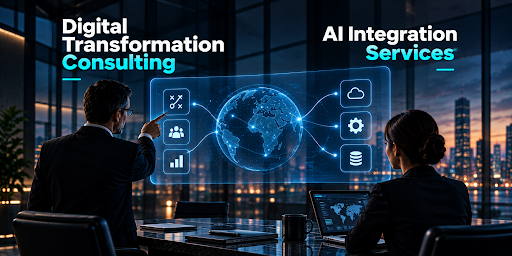
Organizations are investing in artificial intelligence, cloud platforms, automation and advanced analytics to improve productivity and modernize operations. Yet implementing new technologies independently can create fragmented systems and disconnected workflows. Digital transformation consulting helps organizations define how processes, data, technology and operating models should evolve together, while AI integration services connect artificial intelligence with the enterprise systems where work actually occurs.
This combination is increasingly important as organizations move from AI experimentation toward enterprise implementation. AI capabilities need access to appropriate data, applications and workflows if they are expected to create sustainable business value.
This article explores how digital transformation consulting and AI integration services work together, key enterprise applications, business benefits and the priorities organizations should consider when building AI-enabled operations.
What is digital transformation consulting?
Digital transformation consulting helps organizations redesign processes, technology environments and operating models to improve business performance.
The scope can include enterprise applications, cloud infrastructure, data and analytics, artificial intelligence, automation, cybersecurity and workforce transformation.
Consultants typically assess current capabilities, identify performance gaps and define a future-state roadmap. This allows organizations to prioritize investments based on business value, feasibility and strategic importance.
Rather than treating technology projects independently, digital transformation consulting creates an integrated view of how digital capabilities should support enterprise objectives.
What are AI integration services?
AI integration services connect artificial intelligence capabilities with existing enterprise applications, data sources and business workflows.
An AI model operating independently may generate useful information, but its value can remain limited if employees must manually move information between the AI tool and their existing systems.
Integration enables AI to work within platforms such as ERP, CRM, HR, procurement, supply chain and IT service management systems.
AI integration services can also connect models with enterprise knowledge, APIs, automation platforms and security controls so intelligent capabilities operate within established business processes.
Why digital transformation and AI integration need to work together
Artificial intelligence depends on the broader digital environment surrounding it.
Organizations may identify valuable AI opportunities but discover that fragmented data, legacy applications or inconsistent processes prevent implementation at scale.
Digital transformation consulting helps address these foundational issues. Processes can be simplified, data strengthened and architecture modernized before advanced capabilities are expanded.
AI integration services then connect those capabilities with enterprise systems and workflows.
This prevents organizations from creating isolated AI tools that employees must use separately from their everyday work.
Core components of enterprise AI integration
Several capabilities are important when connecting AI with enterprise technology.
Enterprise data
AI applications require access to reliable and appropriately governed information. Integration should provide relevant context without exposing unnecessary or restricted data.
APIs and system connectivity
Application programming interfaces and integration technologies allow AI applications to exchange information with enterprise platforms.
Workflow automation
Automation connects AI-generated insights with predefined business processes and approved actions.
Identity and access management
AI applications should follow enterprise permissions so users and systems access only information they are authorized to use.
Monitoring and governance
Organizations need visibility into how AI applications perform, which information they access and what actions they initiate.
AI integration services bring these capabilities together within the enterprise architecture.
Where AI integration creates business value
AI can be integrated across multiple functions.
Finance
AI can connect with financial systems to support reporting, exception analysis, knowledge retrieval and financial decision support.
Human resources
Integrated AI can improve employee self-service, HR case management, onboarding and access to workforce information.
Procurement
AI integration services can connect intelligent capabilities with sourcing, contract and purchasing systems to improve procurement workflows.
Supply chain
AI can work with planning, inventory and logistics platforms to support analysis and exception management.
Information technology
AI can integrate with IT service management, development and monitoring platforms to improve incident resolution and technical productivity.
Customer operations
Connected AI can use approved customer information to support service employees and intelligent self-service.
These applications demonstrate why integration is critical to moving AI from experimentation into business operations.
Business benefits of AI integration services
Effective integration can improve several dimensions of enterprise performance.
Greater employee productivity
Employees can access AI capabilities within familiar workflows instead of moving manually between disconnected applications.
Faster processes
Integrated systems can reduce manual data transfers and enable AI-supported workflow automation.
Better information access
AI applications can retrieve appropriate enterprise context when responding to employee or customer requests.
Greater scalability
Common integration capabilities can be reused across multiple AI applications and business functions.
Stronger governance
Centralized architecture and access controls can provide greater visibility into how AI interacts with enterprise information and systems.
How digital transformation consulting supports AI readiness
Before implementing AI at scale, organizations need to determine whether their processes and technology foundations are ready.
Digital transformation consulting can assess enterprise architecture, applications, data, workflows and operating models to identify potential barriers.
For example, an AI application may require customer information from several disconnected systems. A transformation roadmap may first need to address data integration or master data issues.
Similarly, organizations should simplify unnecessarily complex workflows before connecting AI to them.
This ensures AI integration services are applied to a stronger digital foundation.
Building an AI integration roadmap
Organizations should avoid attempting to integrate every AI capability simultaneously.
A practical roadmap can begin by identifying high-value use cases and determining which enterprise systems, data sources and workflows each requires.
Leaders can then evaluate dependencies and establish priorities.
The roadmap should address:
- Business objectives and expected outcomes.
- Required enterprise data.
- Applications and systems requiring integration.
- Architecture and API requirements.
- Identity and access controls.
- Workflow and automation requirements.
- Security and governance.
- Implementation sequencing.
- Performance measures.
Digital transformation consulting can connect these technical decisions with broader business priorities.
Best practices for AI integration
Organizations can improve implementation outcomes by following several principles:
- Start with clearly defined business problems rather than AI products.
- Simplify processes before integrating intelligent capabilities.
- Strengthen enterprise data quality and governance.
- Use scalable integration approaches where possible.
- Apply existing identity and access policies to AI systems.
- Integrate AI into employee workflows rather than creating unnecessary new interfaces.
- Maintain human approval for sensitive and high-impact actions.
- Monitor model outputs and system interactions.
- Measure business outcomes rather than integration activity alone.
- Reuse common architecture across appropriate AI applications.
AI integration services should reduce enterprise complexity rather than introduce another disconnected technology layer.
Common AI integration challenges
Legacy systems are one of the most significant barriers. Older platforms may lack modern interfaces or make real-time information difficult to access.
Data fragmentation can create additional problems when different systems contain inconsistent versions of the same customer, supplier or employee information.
Security is another major consideration. Connecting AI to enterprise applications can expand what an intelligent system can access or potentially do.
Organizations therefore need clearly defined permissions and safeguards.
Integration complexity can also increase costs. Leaders should evaluate whether the expected business benefit of an AI use case justifies the architecture and implementation effort required.
Governance for integrated AI
Governance becomes more important as AI moves from providing information toward interacting directly with business systems.
Organizations need to define what AI can read, recommend, create and execute.
High-risk actions should require appropriate human approval, while automated activities should operate within clearly defined boundaries.
Logs and monitoring should provide visibility into important system interactions.
Digital transformation consulting can help connect these controls with broader enterprise governance, while AI integration services implement the technical mechanisms required to enforce them.
Measuring the value of AI integration
Integration success should not be measured by the number of systems connected.
Organizations should determine whether integration improves business performance.
Relevant measures can include process cycle time, employee productivity, automation rates, service resolution, operating costs and user experience.
For example, integrating an AI assistant with an IT service platform should demonstrate improvements in resolution or employee productivity rather than simply showing that the technical connection works.
Establishing performance baselines before implementation helps leaders determine whether expected benefits are being realized.
The future of AI integration services
AI agents will make integration increasingly important.
An AI agent may need to retrieve information from one enterprise system, analyze it and initiate an authorized action in another. Multiple agents may eventually coordinate activities across functions and platforms.
This will require robust integration architecture, standardized permissions and stronger governance.
Digital transformation consulting will increasingly focus on designing operating models and technology environments capable of supporting intelligent workflows, while AI integration services will provide the connectivity needed to make those workflows operational.
The result could be a shift from standalone AI applications toward more deeply integrated intelligent enterprises.
Conclusion
Digital transformation consulting provides the strategic framework required to modernize processes, data, technology and operating models. AI integration services connect intelligent capabilities with the enterprise applications and workflows where business value is created.
Organizations that bring these disciplines together can move beyond isolated AI pilots toward scalable, integrated operations. By simplifying processes, strengthening data foundations and establishing appropriate governance, businesses can use AI integration to improve productivity, accelerate workflows and create sustainable enterprise value.