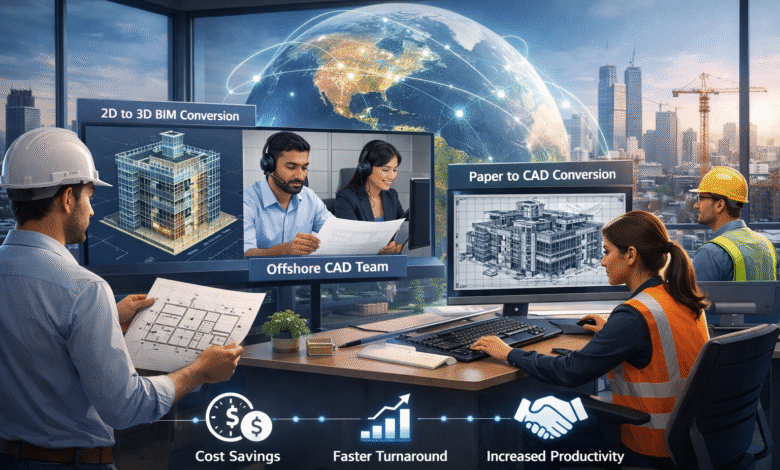
In today’s fast-moving Architecture, Engineering, and Construction (AEC) industry, profitability is no longer driven only by winning more projects, it’s driven by executing them smarter. Rising labor costs, talent shortages, compressed timelines, and increasing design complexity are forcing global AEC companies to rethink how and where they get their technical work done.
One strategic shift gaining strong momentum across the USA, UK, and other mature markets is the use of offshore CAD conversion services. From converting legacy paper drawings into intelligent CAD files to transforming 2D plans into detailed 3D models, offshore CAD conversion has become a powerful lever for improving ROI without compromising quality.
But how exactly does offshore CAD conversion help AEC firms improve returns? What trends are shaping this approach in 2026 and beyond? And what challenges should decision-makers be aware of?
Let’s explore how global AEC companies are using cad conversion services as a competitive advantage and why this model continues to grow.
What Are CAD Conversion Services, and Why Do They Matter?
At its core, CAD conversion services involve transforming design data from one format to another while preserving accuracy, scale, and design intent. This includes:
- Paper drawings to CAD
- PDF to AutoCAD conversion
- 2D drawings to 3D models
- Legacy CAD formats to modern standards
- Raster to vector conversion
For AEC firms, these services are not just technical necessities they are critical to:
- Reducing rework and design conflicts
- Enabling BIM workflows
- Supporting renovations and retrofits
- Improving collaboration across teams
According to Autodesk, nearly 70% of construction rework is caused by inaccurate or outdated drawings, highlighting the importance of an accurate CAD conversion service in project success.
Why Are Global AEC Companies Choosing Offshore CAD Conversion?
Is Cost Reduction the Only Driver?
Cost savings are a major factor but not the only one.
AEC firms in the UK and USA face high operational costs and an ongoing shortage of skilled CAD professionals. Offshore CAD conversion services offer access to experienced drafting teams at a fraction of the cost, without sacrificing turnaround time.
However, global firms are increasingly choosing offshore partners for strategic reasons, including:
- 24/7 productivity across time zones
- Faster project turnaround
- Scalability during peak workloads
- Access to specialized CAD and 3D modeling expertise
A report by McKinsey highlights that companies using global delivery models can reduce design and drafting costs by 30–50%, directly improving project ROI.
How Do Offshore CAD Conversion Services Improve ROI?
Can Outsourcing Really Increase Profit Margins?
Yes, and in more ways than one.
Here’s how offshore cad conversion services in USA- and UK-led projects contribute to better ROI:
- Lower labor costs without compromising output quality
- Reduced overheads related to hiring, training, and infrastructure
- Faster project delivery, enabling firms to take on more work
- Improved accuracy, minimizing costly revisions and RFIs
By outsourcing repetitive and time-intensive CAD conversion tasks, onshore teams can focus on high-value activities such as design development, client coordination, and innovation.
Why Is 3D CAD Conversion Becoming a Global Standard?
Are 2D Drawings Still Enough?
In short, no.
With the rise of BIM, digital twins, and immersive visualization, 3D CAD conversion services are rapidly becoming the industry norm. Global AEC companies are using offshore teams to convert 2D drawings into precise 3D models that support:
- Clash detection and coordination
- Quantity take-offs and cost estimation
- Better stakeholder visualization
- Smooth BIM integration
According to MarketsandMarkets, the global 3D CAD market is expected to grow at a CAGR of over 6% through 2028, driven largely by AEC demand for smarter design workflows.
How Do Offshore Teams Maintain Accuracy and Standards?
Can Offshore CAD Conversion Be Trusted for High-Quality Output?
This is one of the most common concerns and a valid one.
Leading offshore providers follow strict quality control processes aligned with USA and UK standards, including:
- Multi-level QA and QC checks
- Compliance with AIA, RIBA, and ISO drafting standards
- Use of standardized layer naming, line weights, and annotations
- Dedicated project coordinators for communication clarity
Many offshore partners now operate as extended teams, using the same CAD platforms, file standards, and collaboration tools as their onshore clients.
The result? An accurate CAD conversion service that meets regulatory and client expectations.
What Role Does Technology Play in Offshore CAD Conversion?
Are AI and Automation Changing CAD Conversion?
Absolutely.
Modern offshore CAD conversion providers are integrating advanced tools such as:
- AI-assisted vectorization for faster raster-to-CAD conversion
- Cloud-based collaboration platforms
- BIM-ready workflows
- Automated layer and block standardization
According to Deloitte, firms that combine outsourcing with digital automation see productivity gains of up to 40% compared to traditional in-house workflows.
This tech-enabled approach ensures offshore CAD conversion is not just cheaper but smarter.
What Challenges Should AEC Firms Be Aware Of?
Is Offshore CAD Conversion Always Risk-Free?
While the benefits are significant, there are challenges that decision-makers must manage carefully:
- Communication gaps due to time zones
- Data security concerns
- Inconsistent quality with inexperienced vendors
- Lack of industry-specific knowledge
These risks can be mitigated by:
- Choosing partners with proven AEC experience
- Establishing clear SOPs and documentation
- Using secure file-sharing and NDAs
- Running pilot projects before scaling
The key is not just outsourcing but strategic outsourcing.
Why Is Offshore CAD Conversion Especially Popular in the USA and UK?
What’s Driving Demand in These Markets?
In both the USA and UK, several factors are accelerating adoption:
- Aging infrastructure requiring renovation and retrofitting
- Large volumes of legacy paper and PDF drawings
- Skilled labor shortages in CAD and BIM roles
- Pressure to deliver projects faster and more cost-effectively
As a result, many firms rely on offshore cad conversion services in USA-linked projects to modernize drawings while staying competitive.
The UK Construction Industry Training Board (CITB) reports a need for over 250,000 additional construction professionals by 2028, making outsourcing an essential support strategy.
How Are Startups and Mid-Sized Firms Using Offshore CAD Conversion?
Is This Model Only for Large Enterprises?
Not at all.
Startups and mid-sized AEC firms are often the biggest beneficiaries. Offshore CAD conversion allows them to:
- Compete with larger firms without expanding overhead
- Scale resources up or down based on project load
- Maintain lean, agile operations
For growing firms, outsourcing CAD conversion is often the difference between sustainable growth and burnout.
What Opportunities Lie Ahead for Offshore CAD Conversion?
What Does the Future Look Like?
Looking ahead, offshore CAD conversion services will play an even bigger role in:
- BIM-to-BIM and CAD-to-BIM workflows
- Digital twin development
- Smart city and infrastructure projects
- Sustainable and retrofit-focused design
As global AEC firms embrace digital transformation, offshore CAD partners will increasingly act as long-term collaborators, not just vendors.
Conclusion:
For global AEC companies navigating tight margins, talent shortages, and rising complexity, offshore cad conversion services offer a practical, proven path to better ROI.
When executed correctly, offshore CAD conversion delivers:
- Cost efficiency
- Faster delivery
- High accuracy
- Scalability
- Competitive advantage
While success depends on choosing the right partner and processes, the trend is clear: offshore CAD conversion is no longer a cost-cutting tactic, it’s a strategic growth enabler.
As many firms in the UK, USA, and globally have discovered, working with a leading UK CAD design company or an experienced offshore partner can help future-proof operations while delivering measurable business value.
In a world where efficiency defines success, offshore CAD conversion isn’t just an option it’s an opportunity.
FAQs
1: What are CAD conversion services in the AEC industry?
CAD conversion services involve converting paper drawings, PDFs, raster files, or legacy formats into editable 2D or 3D CAD files. In the AEC industry, they help architects and engineers modernize drawings, improve accuracy, and enable BIM-ready workflows for projects in the UK, USA, and globally.
2: Why do global AEC companies outsource CAD conversion services offshore?
Global AEC companies outsource offshore to reduce operational costs, access skilled CAD professionals, speed up project delivery, and scale resources easily. Offshore CAD conversion services often deliver the same quality standards as in-house teams at significantly lower costs.
3: Are offshore CAD conversion services reliable for USA and UK projects?
Yes, reliable offshore providers follow AIA, RIBA, ISO, and local drafting standards, making them suitable for cad conversion services in USA and UK-based projects. Quality assurance processes and secure data handling ensure compliance and accuracy.
4: How do 3D CAD conversion services improve project ROI?
3D CAD conversion services improve ROI by enabling clash detection, better visualization, accurate quantity take-offs, and smoother BIM integration. This reduces design errors, rework, and delays saving both time and money.
5: What challenges should AEC firms consider before outsourcing CAD conversion?
Common challenges include communication gaps, time zone differences, data security, and inconsistent quality. These can be mitigated by choosing an experienced offshore partner, setting clear standards, and starting with a pilot project.
6: How does an accurate CAD conversion service reduce rework?
An accurate CAD conversion service ensures correct scaling, layering, annotations, and compliance with project standards. This minimizes design discrepancies, RFIs, and construction-stage changes directly reducing costly rework.
7: Is offshore CAD conversion suitable for small and mid-sized AEC firms?
Yes. Small and mid-sized AEC firms benefit significantly from offshore CAD conversion by lowering overhead costs, accessing expert resources, and staying competitive with larger firms especially in the UK and USA markets.