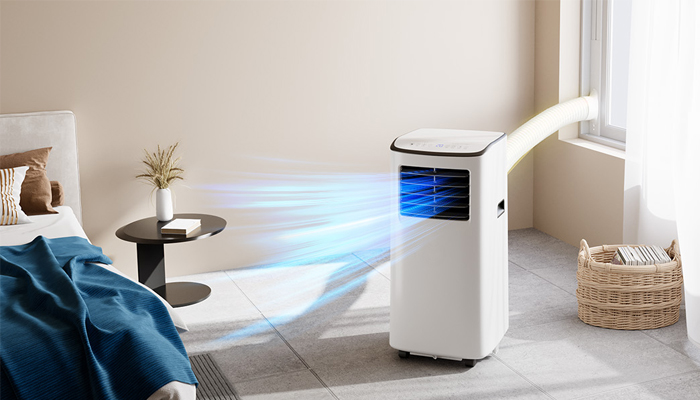
Summer heat sneaks up on you quickly. One day you’re enjoying shorts and t-shirts, the next you’re wondering how you’ll survive sweaty office hours and muggy mornings. It seems like a portable air conditioner is the perfect solution. Move it from room to room, install it in minutes with no contractor needed, and enjoy sweet cold air flowing in minutes.
Before you plug one into your living room wall, however, you’re probably wondering how much it’s going to cost you to run. Does portable AC electricity use make owning one worthwhile? The short answer is that yes, movable ACs consume quite a bit of electricity. But it’s more complicated than that. Let’s take a closer look at how much electricity these units use and how much it might cost you to run.
How Much Electricity Do Portable Air Conditioners Use?
Portable AC units typically range from 800 watts to 1,500 watts. That puts them in line with power usage by hair dryers and small space heaters. Let’s say you have a mid-sized unit that uses about 1,200 watts. Here’s how you’d estimate its energy consumption.
Watts x Hours / 1,000 = Kilowatt-hours (kWh)
Plug those numbers into your calculator. A one-hour session at 1,200 watts equals 1.2 kWh. Running your unit for four hours would equal 4.8 kWh. Pretty simple!
Here’s an example of what your monthly costs would look like if you run your mobile air conditioner for four hours per day.
- 1,500 watts x 4 hours = 6 kWh per day
- 6 kWh x $0.16/kWh (average electricity cost) = $0.96/day
- $0.96 x 20 days/month = $19.20 per month
BTU Size and Electricity Consumption
BTU means British Thermal Unit. Every air conditioner has a BTU rating, which describes how much heat it can remove from a room in one hour. BTU size has a big impact on power consumption. The larger the BTU rating, the more cooling power the unit has, but also the more electricity it uses.
For example, here are two common sizes of mobile air conditioners. The small units average around 6,000 BTUs and use between 890 watts and 1,000 watts of power. Mid-size units range around 10,000 BTUs and require between 9.4 amps and 12.6 amps.
Based on a standard residential voltage of 120 volts, those amps translate into anywhere from 1,128 watts to 1,512 watts required by the larger unit. That’s a big jump in electricity use for doubling the BTU size.
For most rooms, a transportable air conditioner that delivers between 8,000 and 10,000 BTUs is plenty of cooling power. There’s no need to oversize your air conditioner. An oversized air conditioner turns on and off more frequently, wasting energy and leaving you feeling clammy.
Single vs. Dual Hose Electricity Usage
There are two basic types of air conditioners. There are single-hose units, and dual-hose models. The difference matters when it comes to electricity use.
Single hose units suck air into the device from the room, cool it down, and vent hot air outside through a single exhaust hose. Most models consume anywhere from 1,040 watts to 1,200 watts.
Dual hose portable air conditioners improve upon the design by using one hose to suck in outdoor air while expelling hot air through a second hose. Dual hose models require more electricity to power two fans instead of one. On average, they consume between 1,250 watts and 1,341 watts.
However, dual-hose units cool faster and therefore run less frequently than single hose models. A dual hose unit may actually cost you less to run than a single hose easily carried air conditioner.
Comparing Portable AC Electricity Use Against Other Cooling Options
Portable air conditioners are convenient, but they are far less efficient than other cooling methods. Window units use less electricity to create the same amount of cooling power. Central air is even more efficient at cooling your entire home.
If we compare apples-to-apples with a mini-split system, which is basically a ductless window unit mounted to your wall, movable air conditioners lose the battle. A mini-split uses about half the electricity compared to a transportable unit with the same BTU rating. That may not sound like much, but over several months that adds up to serious cash. Every little bit of savings helps when trying to keep your electric bill down.
Tips to Reduce Electricity Use By Your Portable Air Conditioner
There’s no need to crank your portable AC all day long if you don’t want to. Here are a few tips to reduce how much electricity your easily carried AC will consume.
- Set your unit to about 78 degrees Fahrenheit. Lowering the temperature by even one degree will cause your AC to consume more power.
- Use timer settings if available. Set your portable AC to turn off when not needed. Why cool an empty house? Run the unit one hour before returning home.
- Close off the room you’re in. Keep cool air where you want by shutting doors and windows. Don’t try to cool two rooms with one portable AC unit.
- Use a fan in conjunction with your AC unit. Ceiling fans and box fans can work with your portable air conditioner to evenly distribute cool air.
- Clean or replace your easily carried AC’s filter frequently. When dirty, your unit will have to consume more electricity to push air through a dirty filter.
Cost of Running A Portable Air Conditioner Per Month
Running costs depend on how often you use your portable air conditioner. Electricity rates also vary depending on where you live. Here are a few estimates based on light, moderate, and heavy usage.
- Light usage = about $19 – $25 per month (4 hours/day for 20 days/month)
- Moderate usage = about $40 – $80 per month (6 to 8 hours/day for 30 days)
- Heavy use = $150+ per month (running most of the day)
Conclusion: Are Portable Air Conditioners Worth The Electricity Use?
The average electricity rates across the country hover around 16 cents per kWh. Since electricity costs tend to rise during the hot summer months here in Texas we pay closer to $0.18-$0.20/kWh during the summer season.
Your travelling air conditioner is going to pull quite a bit of electricity when you run it. But that doesn’t mean it isn’t worth it. You just have to be smart about how you use it. Size it correctly for your room and only turn it on when necessary. If you follow these tips, your portable AC’s electricity use won’t break the bank.
Case Study: Experimental Energy Performance Evaluation Of A Portable Air Conditioner
Transportable air conditioner performance study conducted by engineering researchers using controlled experiments. They wanted to see how changes to a portable AC unit could improve its efficiency during typical real‑world use. The portable AC unit tested was a standard model and was operated in high‑humidity indoor conditions.
Quick points:
Tests were performed on altering the condenser path as well as the condensate supply method to measure impact on continuous run performance.
Researchers were able to improve overall unit COP (Coefficient of Performance) by ~8 % by altering how condensate water flowed through the condenser path and optimizing the position of other components. This lets the AC deliver more cooling per kWh of electricity without costing more to buy.
Researchers also found that continuous run was difficult to maintain at humidity levels greater than ~90 %, demonstrating how environmental factors impact energy consumption and cycle times.
Why we care: Mobile AC units can theoretically be modified to use electricity more efficiently than before. However, depending on humidity levels and how the unit is designed/performs, electricity usage may vary greatly from their rated power.
Portables FAQs – Electricity Use
1. Do easily carried air conditioners use a lot of electricity?
Yes. Compared to pedestal fans and other lightweight cooling options, portable air conditioners use more electricity. In some cases, portable units use more power than window air conditioners with equivalent cooling power.
2. What affects how much electricity my portable AC will use?
The primary factors of electricity use are the BTU rating and EER rating of your movable air conditioner as well as how long you run it. The higher the BTU rating and the lower the EER rating, the more electricity your unit will consume.
3. Are dual‑hose portable air conditioners more efficient?
Yes. By pulling outside air into the condenser to cool instead of using only indoor air, dual‑hose portable ACs work with ambient pressure rather than creating negative pressure in the room. This improves efficiency, despite the added power draw of another fan.
4. How do I conserve energy when using my portable air conditioner?
There are a few steps you can take to reduce electricity usage when using your movable AC unit: ensure your unit is properly sized for the room, cover any open windows/doors, use a timer or thermostat, and clean/replace filters regularly.
5. Will a portable AC unit cost less to run than central air?
In most cases, no. A travelling air conditioner is almost always less efficient than whole‑home central air conditioning. However, a portable can cost less to run than your central air if you only need to cool one room.
6. What is the difference between BTU and EER?
BTU stands for British Thermal Unit and measures how many inches of water an air conditioner can freeze in an hour. EER measures how many BTUs you get for every watt of electricity consumed by the unit. The higher the EER rating, the less you’ll pay per hour in power costs.
7. Will my electric bill go up if I use a portable air conditioner?
In most cases, yes. Since portable AC units have to run for longer periods of time than most other cooling methods and are less efficient than centrally installed systems, expect to pay more on your electricity bill if you use yours frequently. However, proper use and correct BTU sizing can limit this effect.