Custom Pallets in Allentown, PA: What Local Businesses Need to Know Before Placing Their First Order

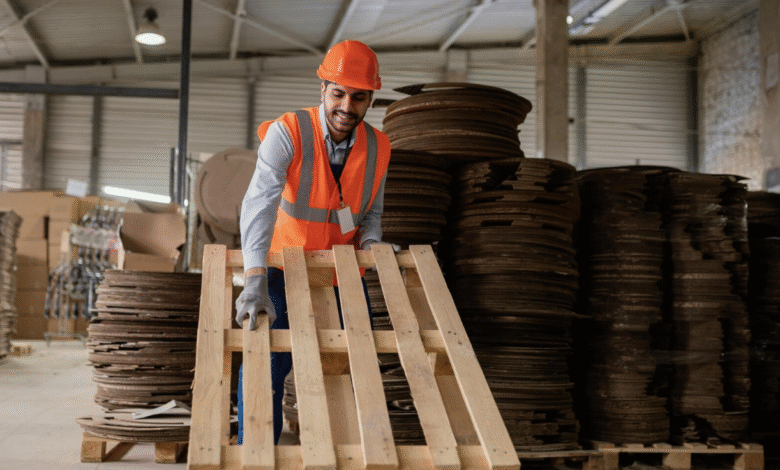
For operations that move product regularly, the pallet is rarely thought about until it becomes a problem. A shipment gets rejected because the deck boards don’t meet a retailer’s specification. A forklift operator flags a structural issue mid-warehouse run. A supplier delivers standard pallets that don’t fit the rack system, and now product sits idle while the issue gets resolved. These are not rare occurrences. They happen consistently in facilities that rely on off-the-shelf pallet solutions for applications that require something more specific.
Businesses in the Lehigh Valley and surrounding areas have been expanding steadily, and with that growth comes more complexity in how product moves through the supply chain. Distribution centers, manufacturers, food processors, and logistics providers operating in and around Allentown face distinct requirements that vary by load type, racking system, transportation mode, and customer compliance standards. Standard pallet dimensions and grade classifications often don’t account for these variations. That’s where the decision to order custom pallets becomes less of a preference and more of an operational necessity.
This guide is written for purchasing managers, operations leads, and logistics coordinators who are evaluating custom pallets for the first time or reconsidering their current pallet sourcing strategy. It covers what to think through before placing an order, how to evaluate a supplier, and what factors tend to create problems when left unaddressed early in the process.
Why Custom Pallets Exist and When Standard Options Fall Short
Custom pallets are built to a specific set of requirements rather than pulled from a catalog of common sizes and configurations. Businesses sourcing custom pallets in Allentown, PA are typically doing so because a standard pallet—whether a GMA-style grocery pallet or a common block pallet—doesn’t fit cleanly into their workflow, rack system, or customer delivery requirements. The distinction matters because the consequences of a poor fit aren’t just cosmetic. They affect product safety, employee safety, load stability, and downstream compliance.
Standard pallets are built for general use across a wide range of industries. They work well when the application is general enough to absorb variation. But once an operation has specific clearance requirements, unusual product weight distribution, temperature-controlled environments, or customer specifications tied to a retail compliance program, standard dimensions and construction may introduce friction that compounds over time.
The Problem with Forcing a Standard Solution into a Specific Application
When businesses use a pallet that doesn’t match their operational requirements, the mismatch tends to show up in a few consistent ways. Product can shift during transit when the pallet deck doesn’t provide adequate surface area or when stringer spacing doesn’t align with the bottom of the load. Racking systems designed around specific pallet footprints may not safely support a pallet that’s narrower or wider than intended. Automated conveyor systems in distribution centers are particularly sensitive to pallet dimensions, and even small deviations can cause jams, delays, or equipment damage.
These problems often get absorbed quietly for a period of time—adjusted for by warehouse staff, managed through slower processes, or tolerated until a near-miss or a customer complaint forces a reevaluation. The cost of that quiet absorption is real, even when it’s not tracked in a line item.
Key Decisions That Shape a Custom Pallet Order
Before approaching any supplier with a request for custom pallets, an operation needs internal clarity on several factors. Suppliers can help refine specifications, but they cannot make structural decisions on behalf of a buyer. The more clearly defined the requirements coming into the conversation, the more accurate the quote, the lead time estimate, and the final product will be.
Load Characteristics and Weight Distribution
The weight of what sits on the pallet and how that weight is distributed across the deck are among the most important inputs to any custom pallet design. A pallet built for a uniformly distributed load behaves differently than one designed for a concentrated load—a piece of equipment, for instance, that rests on a single point rather than spreading evenly across the deck. Suppliers need this information to determine deck board thickness, board spacing, and overall structural configuration. Getting this wrong at the design stage often means discovering the failure under real conditions, which is a worse outcome than taking additional time upfront.
Racking and Storage Environment
Pallet racking systems are designed around specific load capacities and pallet footprints. In selective racking, the pallet must overhang the rail by a consistent amount on each side to distribute the load properly. In push-back or drive-in racking configurations, pallet width tolerance becomes even more critical because the pallet has to move along guides or rails without catching. If the custom pallet dimension doesn’t account for the specific racking configuration, the result can be unsafe storage conditions or rack damage that carries significant replacement costs.
Cold storage environments add another layer of consideration. Wood behaves differently in environments with sustained low temperatures or humidity fluctuations. A pallet that functions well in a dry warehouse may develop structural issues in a refrigerated or frozen storage facility if the wood species and moisture content weren’t accounted for in the design.
Compliance and Downstream Customer Requirements
Many buyers of custom pallets are not the end users of those pallets—they’re moving product to retailers, third-party logistics providers, or distribution centers that have their own pallet standards. Major retailers often require suppliers to deliver on pallets that meet specific dimensional tolerances, weight ratings, or even heat treatment certifications. The International Plant Protection Convention governs phytosanitary standards that affect wood packaging materials crossing certain regulatory thresholds, and ISPM-15 compliance is a requirement for any wood pallet entering international trade channels. Even domestically, some large retail distribution centers enforce pallet compliance programs that result in chargebacks when specifications aren’t met.
Identifying these downstream requirements before designing the pallet prevents the cost of redesigning or reprinting an order after it fails inspection at a customer dock.
Evaluating a Supplier Before Committing to an Order
Custom pallet sourcing is not a commodity transaction. The supplier’s ability to understand operational requirements, produce consistent output, and communicate accurately throughout the order process directly affects the reliability of what arrives on the loading dock. Evaluating a supplier on price alone often leads to quality variance that costs more over time than a modest premium for a more capable provider.
Production Consistency and Quality Control
A custom pallet design is only as useful as the supplier’s ability to reproduce it consistently across an order. When a facility receives a batch of pallets that vary in board spacing, overall dimensions, or fastener placement, those variations create problems in automated systems and in rack environments where tolerance is tight. Asking a potential supplier about their quality control process—how they check for consistency within a run and how they handle variance—gives a clearer picture of what to expect at scale.
Suppliers with established production processes tend to have better dimensional consistency than those relying on informal methods. It’s worth asking how orders are measured and verified before shipment, especially for first-time orders where there’s no prior history to rely on.
Lead Time Realism and Communication
Custom pallet orders take longer than stock pallet orders, and that lead time varies based on order volume, material availability, and the complexity of the design. A supplier who gives an unrealistically short lead time to win the business creates downstream problems when the pallets don’t arrive before a product run is scheduled to ship. Clear, honest communication about production timelines—and what factors might affect them—is a practical indicator of how the relationship will function over time.
It’s also worth understanding how a supplier handles reorders. For operations with recurring custom pallet needs, a supplier who keeps design records and can reproduce an order accurately without re-quoting from scratch reduces administrative burden significantly.
Managing the First Order and Setting a Baseline
The first custom pallet order with any supplier should be treated as a baseline-setting exercise, not just a transaction. Before committing to a large volume, it’s reasonable to request a sample run or a small initial order that can be tested against actual operational conditions. This means running the pallet through the racking system, loading it with product, moving it through the relevant conveyor or automation equipment, and evaluating it against any downstream customer specifications that apply.
Documenting the results of that evaluation—what worked, what needed adjustment—gives the supplier actionable information for refining the design before it’s produced at scale. It also creates a record that can be referenced in future orders or when onboarding a secondary supplier as a backup source.
Operations that skip this step often discover specification mismatches at the worst possible time: during a high-volume production period or when a key customer is waiting on a delivery. The time spent on a controlled first-order evaluation is far less disruptive than resolving a systematic issue under production pressure.
Closing Thoughts
Custom pallets are not a niche product—they’re a practical solution for operations where standard pallet configurations create friction, risk, or downstream compliance problems. For businesses in the Allentown area dealing with the realities of racking specifications, customer compliance requirements, and product-specific load characteristics, the decision to move toward custom pallets is usually driven by experience with the costs of the alternative.
The most important thing a buyer can do before placing a first order is to arrive at that conversation with internal clarity: what the load looks like, what the storage environment requires, what the downstream customer expects, and what the production timeline realistically needs to be. A supplier working with well-defined requirements can produce a more accurate quote, a more consistent product, and a more reliable long-term relationship. That clarity is the buyer’s responsibility, and it’s the foundation everything else is built on.
Custom pallet sourcing done carefully at the outset tends to stay stable over time. Done without adequate preparation, it tends to generate recurring problems that are difficult to trace back to their origin. The upfront investment in getting the specifications right is the most cost-effective part of the entire process.