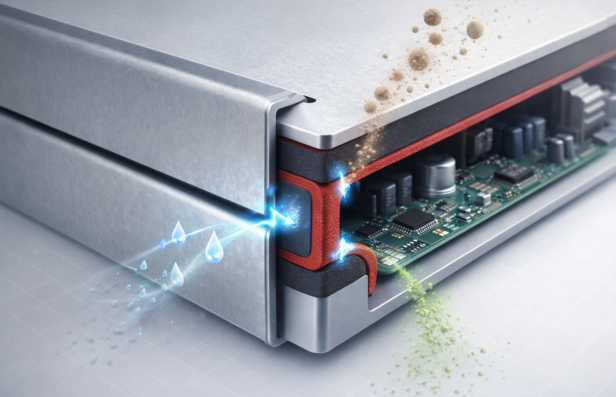
Electronic assemblies operate in environments where exposure to moisture, dust, chemicals, and airborne contaminants is unavoidable. In industrial equipment, medical devices, transportation systems, and outdoor installations, environmental intrusion is one of the leading causes of electronic failure.
Gaskets play a critical role in preventing this intrusion. They create compression seals between mating surfaces, forming a barrier that protects sensitive circuitry from external elements. When engineered correctly, gaskets significantly improve reliability, reduce maintenance, and extend product lifecycle.
Understanding how gaskets function in electronic assemblies requires examining sealing mechanics, material selection, and environmental protection standards.
What Is a Gasket in Electronic Applications?
A gasket is a compressible sealing component placed between two surfaces to prevent the passage of fluids, particles, or gases.
In electronic assemblies, gaskets are commonly used between:
- Control panel enclosures
- Display windows and housings
- Membrane switch assemblies and mounting surfaces
- Access panels and protective covers
- Connector interfaces
When compressed between surfaces, the gasket conforms to microscopic irregularities, creating a tight seal.
Primary Environmental Threats to Electronic Assemblies
Electronic assemblies are vulnerable to multiple environmental hazards.
1. Moisture and Water Exposure
Moisture intrusion can cause:
- Electrical short circuits
- Corrosion of conductive traces
- Swelling of substrates
- Delamination of bonded layers
Even small amounts of condensation can degrade long-term electrical performance.
2. Dust and Particulate Contamination
Fine particles can:
- Accumulate on circuitry
- Cause abrasive wear
- Interfere with mechanical components
- Create unintended conductive paths
Dust intrusion is particularly common in manufacturing facilities and outdoor equipment.
3. Chemical and Industrial Contaminants
Electronic assemblies may be exposed to:
- Cleaning agents
- Solvents
- Oils and lubricants
- Industrial vapors
Certain contaminants can degrade adhesives, plastics, and conductive materials.
How Gaskets Create a Protective Seal
Gaskets protect electronic assemblies through compression sealing.
When installed properly:
- The gasket is positioned between two rigid surfaces
- Fasteners apply compression force
- The gasket material deforms to fill gaps
- A continuous seal is formed
This compression seal blocks pathways that contaminants would otherwise use to enter the enclosure.
Seal effectiveness depends on:
- Material compressibility
- Surface flatness
- Compression force
- Environmental conditions
Proper compression is essential. Too little compression results in leakage. Excessive compression may cause material failure.
Types of Gasket Materials Used in Electronics
Material selection is critical to long-term performance.
Common gasket materials include:
- Closed-cell foam
- Silicone rubber
- Neoprene
- EPDM rubber
- Conductive elastomers
- Poron polyurethane
Closed-cell materials are often preferred because they resist moisture absorption.
Silicone offers strong temperature stability.
EPDM provides resistance to water and environmental exposure.
Material selection depends on:
- Required IP rating
- Chemical exposure
- Temperature range
- Mechanical compression characteristics
IP Ratings and Ingress Protection
Gaskets are frequently used to achieve specific ingress protection levels.
IP ratings classify protection against solids and liquids.
For example:
- The first digit indicates protection against solid particles
- The second digit indicates protection against water
To meet higher IP ratings, gasket systems must maintain seal integrity under defined testing conditions.
This may include:
- Dust chamber testing
- Water spray testing
- Temporary immersion testing
Proper gasket design supports compliance with these standards.
Role of Gaskets in Membrane Switch and HMI Assemblies
In Human Machine Interface systems, gaskets are often installed between the interface assembly and the mounting surface.
They provide:
- Dust and moisture sealing
- Gap compensation
- Vibration damping
- Surface irregularity compensation
In membrane switch assemblies, gasket integration improves environmental sealing while maintaining a low-profile design.
Because interfaces are exposed surfaces, gasket performance directly impacts system reliability.
Conductive Gaskets for EMI Shielding
In some electronic assemblies, environmental protection must also address electromagnetic interference.
Conductive elastomer gaskets provide:
- Environmental sealing
- Electrical grounding continuity
- EMI shielding support
These gaskets prevent both particulate intrusion and electromagnetic leakage.
In sensitive electronic systems, combined environmental and EMI protection improves performance stability.
Design Considerations for Effective Gasket Sealing
Proper gasket performance depends on careful engineering.
1. Compression Ratio
The gasket must be compressed within its optimal range.
Engineers evaluate:
- Recommended compression percentage
- Material recovery properties
- Long-term compression set behavior
2. Surface Flatness and Alignment
Mating surfaces must:
- Be properly aligned
- Avoid excessive gaps
- Maintain even compression
Uneven compression can create leak paths.
3. Adhesive Integration
In some designs, gaskets include pressure-sensitive adhesive backing.
Adhesive selection must account for:
- Temperature resistance
- Humidity exposure
- Chemical compatibility
- Long-term bond durability
Adhesive failure can compromise seal integrity.
Long-Term Reliability and Maintenance Benefits
Effective gasket sealing reduces failure risks.
Benefits include:
- Reduced corrosion of internal components
- Lower maintenance frequency
- Improved electrical reliability
- Extended product lifecycle
- Reduced warranty claims
In harsh environments, environmental intrusion is a primary cause of electronic failure. Gasket systems mitigate that risk.
Engineering Perspective on Contamination Prevention
Contamination prevention is not solely about enclosure design. It requires an integrated sealing strategy.
Gaskets contribute by:
- Closing micro gaps between surfaces
- Compensating for manufacturing tolerances
- Maintaining compression under vibration
- Resisting environmental degradation
In industrial electronics, sealing design must account for real-world operating stress, not just laboratory conditions.
Why Gaskets Are Critical in Modern Electronic Design
As electronic assemblies become more compact and integrated, exposure risk increases.
Gaskets remain critical because they:
- Protect sensitive circuitry
- Support IP compliance
- Maintain structural integrity
- Reduce environmental failure modes
- Enhance overall system reliability
Without proper gasket integration, electronic assemblies are vulnerable to moisture, dust, and contaminant intrusion.
Sealing is a foundational reliability strategy, not an optional enhancement.
Frequently Asked Questions
What does a gasket do in an electronic assembly?
A gasket creates a compression seal between surfaces to prevent moisture, dust, and contaminants from entering the enclosure.
What materials are used for electronic gaskets?
Common materials include closed-cell foam, silicone, EPDM, neoprene, and conductive elastomers.
How do gaskets help achieve IP ratings?
By sealing gaps between enclosure surfaces, gaskets prevent solid and liquid ingress during IP testing.
Can gaskets protect against EMI?
Yes. Conductive elastomer gaskets provide both environmental sealing and electromagnetic shielding.
Why is compression important for gasket performance?
Proper compression ensures the gasket fills surface irregularities and maintains a continuous seal.