Avoid 4-Week Delays: How to Choose the Right Rapid Prototyping Service for Functional & Aesthetic Validation

Introduction
During the product development sprint, product development teams often get stuck because of prototypes which fail functional testing or appearance review, leading to critical path issues of up to four weeks of delay. Confusion in selecting suppliers, i.e., blindly switching between 3D printing, CNC machining, and vacuum casting technologies, not only wastes budget but also, more importantly, squanders the much-needed time-to-market window.The underlying issue is that “rapid prototyping” is often treated as a single service, not selecting a specific “technology matrix” against the validation goal of testing for “fit,” “bearing load,” or “feeling and looking.” The absence of a systematic approach forces the selection of a technology based on “vague recommendations.”
This article aims to provide a “validation goal-driven” approach for making such decisions. It breaks down the underlying “capability boundaries” of different prototyping technologies and provides a five-dimensional “supplier selection checklist,” which helps readers systematically compress validation cycles and improve the accuracy of prototypes.
Is Your Prototype for “Looks,” “Feels,” or “Works”? Defining Your Validation Goal First.
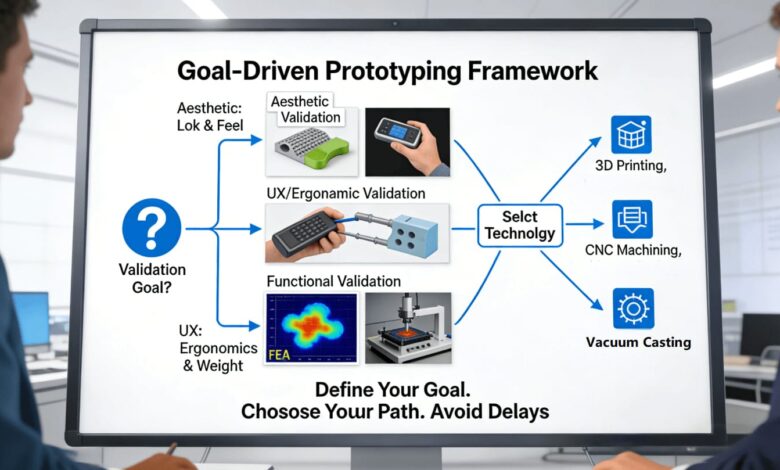
This segment sets the logical starting point for selection, dividing the types of validation prototypes into “aesthetic,” “user experience,” and “functional” validation to avoid costly mismatches from the very start.
1. The Three Pillars of Validation
Prior to any type of technology validation, you must first determine the validation goal of the technology. Is it for:
- Aesthetic Validation: Determining form, color, texture, and visual appeal?
- User Experience (UX) Validation: Determining ergonomics, weight, balance, and haptic response?
- Functional Validation: Determining structural integrity, assembly, thermal, or endurance testing?
Your goal is the most critical selection factor. As discussed in the Society of Manufacturing Engineers (SME) publication, prototypes have different functions at different stages of the product development process, and matching the type of prototype to its intended purpose is a fundamental requirement for efficiency.
2. The High Cost of Misalignment
The cost of misalignment is wasted time and resources. If you choose to validate your high-stress mechanical joint with a fused deposition modeling (FDM) part, for example, you will most likely fail. If you choose to validate the chemical resistance of your part with a stereolithography (SLA) resin part, you may not get the results you expect. By establishing the goal, you ensure that you don’t choose a technology that is not capable of answering your key question.
3. From Vague Need to Specific Requirement
You could initially address the general requirement of “We need a prototype,” but a more precise definition of the need could be “We need a prototype to test the assembly sequence” of five internal components under simulated vibration and having the same material properties as the final product. Such a precise description helps to instantly identify the limited technologies that suit your needs and is the first step to creating a successful partnership with your supplier.
3D Printing vs. CNC Machining vs. Vacuum Casting: Which Technology “Maps” to Your Goal?
This section will give you a clear decision chart that compares the pros, cons, and best uses of the three most dominant RP techniques to help you select the appropriate one based on your goal.
1. 3D Printing: The Champion of Complexity and Speed
Additive manufacturing, also called 3D printing, is the best way to create geometrically complex parts that cannot be created using any other manufacturing process with the least lead time for the first piece. Resin-based 3D printing techniques like SLA produce excellent quality parts for cosmetic mockups. Another advantage of 3D printing is that it can produce functional moving parts with no support structure using SLS. However, most 3D parts tend to be anisotropic in nature, i.e., the material properties vary in different directions. Also, the material properties might not exactly match the material properties of the final material used in the parts, which can affect the results of the functional testing of the parts.
2. CNC Machining: The Gold Standard for Fidelity and Performance
CNC machining is a subtractive process that cuts parts directly out of solid blocks of actual engineering materials like aluminum, steel, PEEK. This is the real thing for isotropy and material properties. This is the definitive process for validation of strength, fatigue, and thermal performance. It is the most accurate process with the best finishes directly from the machine. Its weakness is geometric; it cannot make certain kinds of internal, “trapped” geometries without cracking the part. In order to fully understand the technical concepts, material scope, and cost models associated with these mainstream rapid prototyping services, this definitive guide offers a thorough analysis.
3. Vacuum Casting: The Bridge to Low-Volume Production
Vacuum casting, also called urethane casting, is a process that creates multiple copies of a part by casting polyurethane resins into a silicone mold that is originally produced with a CNC machine or a 3D printer. It is the most cost-efficient way to produce small batches (10-50 parts) with a close simulation of the look, feel, and some mechanical properties of injection-molded plastic parts.
Beyond the Machine List: The 5-Point Checklist for Vetting a Rapid Prototyping Partner.
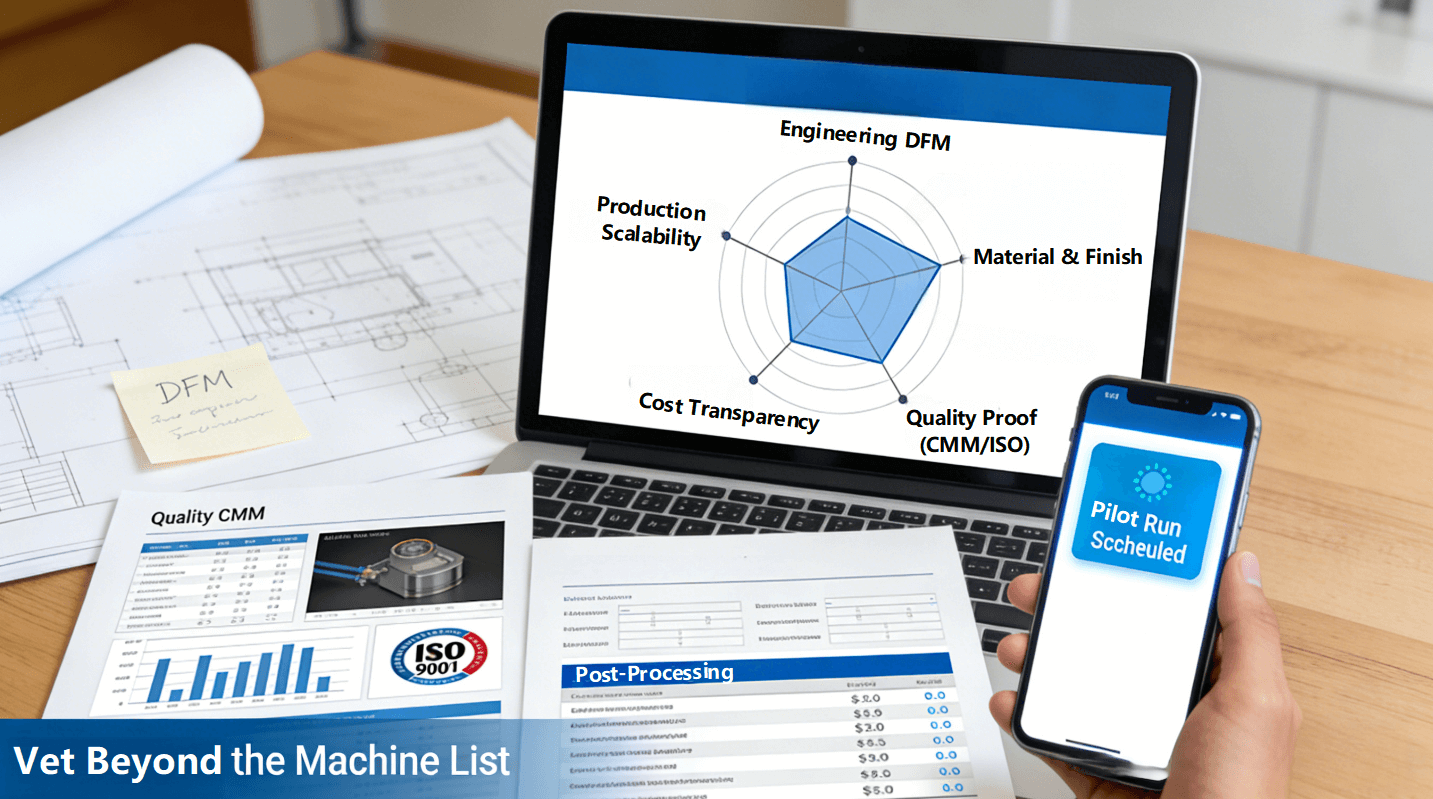
This section of the article moves beyond the equipment itself to offer a more detailed, five-dimensional approach to evaluating the true capabilities of the supplier in the areas of engineering support, quality assurance, and potential as a partner.
1. Engineering Collaboration and Proactive DFM
A true partner is one who can offer more than just a quote. During the RFQ process, does the partner offer substantive Design for Manufacturability (DFM) feedback? Does the partner offer suggestions for design changes that could improve stability, cost-effectiveness, or accuracy? The capacity to offer this type of engineering collaboration is a clear measure of whether the partner is engaged in the project’s success or merely interested in fulfilling the order.
2. Material Mastery and Post-Processing Expertise
While it’s easy to offer a variety of materials, does the partner offer a broad array of engineering materials with data sheets? More importantly, does the partner offer extensive knowledge in the post-processing techniques that can be used to achieve the end goal? Does the partner understand the media blasting necessary for texture? Does the partner understand the painting process necessary for color matching?
3. Transparency and Evidence-Based Quality
It is very easy for anyone to announce quality superiority. The best partners prove it. Do they proactively and routinely make inspection results (CMM data, photos of critical features) available to customers as part of the proposal? Do they have a certified quality management system (such as ISO 9001)? Such systems imply the existence of process controls and traceability, thus improving significantly the signal, to, noise ratio of your prototype data and, most importantly, guaranteeing that the piece really corresponds to the process capability.
How to Decode a Rapid Prototyping Quote: Spotting Hidden Costs and Value Gaps.
This section will walk you through how to analyze a supplier’s quote for transparency and total cost. Here are some important line items to watch for.
- Deconstructing the Unit Cost: A clear quote should provide cost itemization. Analyze the material cost. Does it include the net part volume plus a material yield factor? Analyze the machine time estimate. Was it determined using CAM simulation or actual data? Be wary if the price is low with unrealistic machine times. Unrealistic times will most likely result in change orders. A clear quote should separate programming fees from unit run costs.
- The Devil in the Details: Post-Processing and Handling: A large percentage of cost overruns happen in secondary processing. Does the quote provide itemization for support removal, surface finishing (sanding, bead blasting), as well as any finishing operations (painting, plating)? Are there costs associated with special packaging and/or shipping? A detailed itemized quote is a sign of excellent process management by the supplier.
- Assessing Value Beyond Price: A slightly higher price quote may, in fact, be more valuable. Does it come with an inspection report on the first article? Does it enable small design changes without charging an arm and a leg for a change fee? The quality of the price quote itself is a reflection of the supplier’s professionalism and reliability. Thus, a good quote and timely delivery are often contingent upon the strong foundation provided by a well-run CNC prototyping service factory.
From Prototype to Pilot Run: Can Your Supplier Grow with Your Project?
This final section of the assessment will determine the supplier’s strategic value by evaluating their ability to grow with your project.
1. Process Alignment for Seamless Scaling
Very often, what distinguishes the top, tier partners is that they think beyond the prototype stage. For example, do they incorporate production, representative processes and materials during the prototyping? If you take 6061, T6 aluminum as an example and machine a prototype from it, then you get direct production data for a run of that same material. Process alignment turns the prototyping phase into an actual launch point instead of a standalone event.
2. Quality System Scalability
You must have a quality system that can be scaled up to meet your needs. Are you thinking of a pilot, level production stage? Does the supplier quality management system (QMS) have the features to support the advanced controls, documentation, and traceability that the automotive industry mandates with IATF 16949? A quality system that keeps the standard from the first prototype up to the thousandth production piece is priceless.
3. The Strategic Advantage of a Unified Partner
By utilizing the same partner through the entire process from prototyping to low-volume production, the knowledge transfer gap is eliminated. They know the intent of the design, the problems encountered in the past, and the optimal conditions. This is a strategic advantage that has been recognized in various models for supply chain integration, such as the APICS SCOR model. This can result in a substantial savings in the overall time it takes to get a product from concept to market-ready product, preserving your most valuable asset – time.
Conclusion
Selecting a service for rapid prototyping is an exercise in risk management in the face of uncertainty. By utilizing a goal definition/technology matching/systematic evaluation approach to decision-making, a company can turn a process that is based on past experience into a rational decision. This is a process that can avoid the delays associated with a failed prototype while at the same time ensure that every iteration through the design process is a high-fidelity process that can result in a substantial acceleration in the overall product maturation process.
FAQs
Q: What is the usual difference in lead time between 3D printing and CNC machining for a prototype?
A: Typically, for a single piece of moderately complex geometry, industrial 3D printing (SLA/SLS) can be ready in 2-3 days since it requires little to no setup. CNC machining can take 3-5 days since it requires programming, fixturing, and setup. The decision should be based on which process is better suited to fulfill the validation requirement rather than the speed since a failed validation attempt with the wrong process can cost more in terms of time spent.
Q: How do I verify the actual accuracy that the supplier states is the real world before placing the order?
A: Get the supplier to supply you with the inspection reports of the last projects that used the same tolerances. A trustworthy supplier will be able to provide you with the redacted reports from their CMM inspection equipment or they can give you high, resolution photos of the parts being inspected. If the project is critical, you may want to consider asking the supplier to send a simple test coupon.
Q: Is it economically viable to stick with the same supplier for prototyping and small, batch production?
A: Absolutely, quite often. A supplier who already understands your design through the prototyping phase can facilitate a smoother transition to small, batch production, thus your device parameters won’t have to be re, learned. This can be an effective time and cost saving for the initial small, batch production runs.
Q: What type of example is it most important to give when asking for a quote?
A: In order to get the most exact quote in the shortest time, it is best to give us the following information: 1) 3D CAD file of your device (STEP/IGES format preferred); 2) Indication of critical to function dimensions and tolerance requirements; 3) Your most important validation goal; 4) Desired material properties; 5) Required quantity.
Q: How is your company dealing with a design change during the creation of a prototype?
A: A professional supplier will have a firm and clearly defined system for implementing their engineering change orders. After getting the change request, they will inspect the alteration and get back to the customer with an updated quotation and project schedule. It is well known that early communication is the main factor in controlling the effect and the cost of a change.
Author Bio
Practical hands, on experience in quick design plus lean product development for several years have formed the basis of the article.LS Manufacturing offers a comprehensive package of rapid prototyping services including 3D printing, CNC machining, and vacuum casting, all under one roof. Quality assurance from prototype to production is supported by certified management systems such as ISO 9001 and IATF 16949.Submit your design file now to get a free, pun, oriented technical recommendation and a clear, instant quote.
✅ Read More: QLCredit Explained: The Complete Guide to Hong Kong’s AI-Powered Digital Lending Platform