Master information block: The Foundation of Cellular Network Access
How the Master Information Block Enables Synchronization, Discovery, and Reliable Communication in Modern Mobile Networks

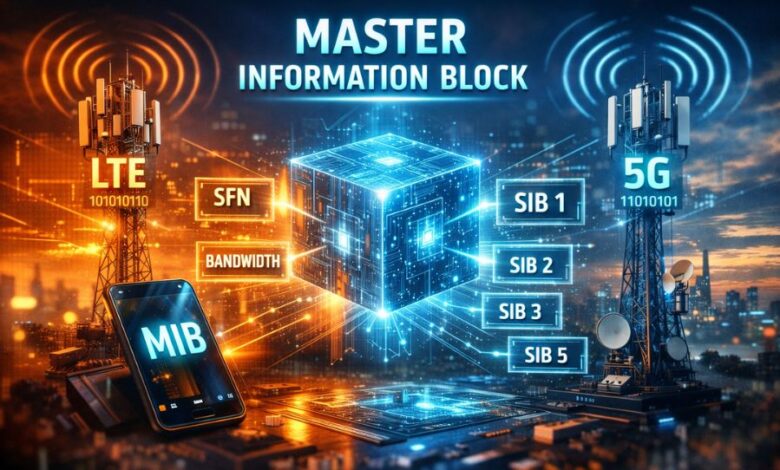
The Master information block is the most fundamental system information message broadcast by cellular base stations in modern mobile communication systems. Every time a mobile device is powered on, moves into a new coverage area, or loses radio synchronization, it must rediscover the network. The Master information block serves as the first trusted signal that enables the device to understand how the cell operates and how to access additional information. Without it, no mobile communication session can begin.
From a network engineering perspective, the Master information block is designed to be extremely compact, highly robust, and universally decodable. Its purpose is not to provide a complete network configuration, but to give just enough information so that the device can reliably proceed to the next stages of system information decoding.
What Is the Master Information Block in Cellular Systems
. The Master information block is a broadcast message transmitted by every LTE and 5G base station. It is sent over the Physical Broadcast Channel. It uses conservative modulation and coding schemes so that even devices at the edge of the cell or under poor radio conditions can successfully decode it.
The Master information block contains essential parameters that define the cell’s basic structure. These parameters allow the user equipment to align its timing, understand the system bandwidth, and locate the control channels required to read additional system information.
Why the Master Information Block Is Critical for Network Entry
The importance of the Master information block lies in its position within the initial access procedure. After a device synchronizes to the primary and secondary synchronization signals, it immediately searches for the Master information block. This step confirms that the device has locked onto a valid cell and is ready to interpret its configuration.
If the Master information block cannot be decoded, the device treats the cell as unusable. This ensures that only properly configured and compatible cells are selected for camping, reducing signaling errors and improving overall network stability.
Master Information Block Transmission Characteristics
The Master information block is transmitted periodically on a fixed schedule. This predictable repetition allows devices to conserve power by waking up only at known intervals to attempt decoding. The block is encoded with robust error-correction techniques and typically modulated using QPSK to maximize reliability.
Because the Master information block must be received by every device regardless of capability, it is standardized and tightly constrained in size. This design ensures backward compatibility and consistent behavior across different vendors and chipsets.
Master Information Block Structure in LTE Networks
In LTE systems, the Master information block is a 24-bit message. Despite its small size, it carries information that defines the cell’s fundamental operating parameters. The block includes the downlink system bandwidth, physical hybrid ARQ indicator channel configuration, and the most significant bits of the system frame number.
These elements allow the device to determine the radio frame timing and correctly interpret scheduling messages that follow. The remaining bits are reserved to support future enhancements without breaking compatibility.
Master Information Block in 5G New Radio
In 5G New Radio, the Master information block is integrated into the Synchronization Signal and PBCH block. While its role remains similar to LTE, its content has evolved to support 5 G’s flexibility.
The Master information block in 5G provides the system frame number, subcarrier spacing, and parameters needed to locate the control resource set that carries System Information Block 1. This reflects the 5G design philosophy, which emphasizes scalability and adaptability across a wide range of frequency bands and deployment scenarios.
How the Master Information Block Enables System Information Blocks
One of the most important functions of the Master Information Block is to guide the device toward decoding System Information Block 1. SIB1 acts as the gateway to all other system information, including cell access rules, mobility parameters, and scheduling details.
The Master information block does not carry these details directly. Instead, it provides the technical instructions needed to find them. This layered approach minimizes broadcast overhead while maintaining fast and reliable access for user equipment.
Role of the Master Information Block in UE Power Efficiency
Power efficiency is a key consideration in mobile device design. The Master information block supports this goal by using deterministic timing and a minimal payload size. Devices can quickly determine whether a cell is suitable without decoding unnecessary information.
By ensuring that the earliest system information is concise and reliable, the Master information block reduces the need for repeated decoding attempts and unnecessary radio activity. This contributes directly to longer battery life and a smoother user experience.
Master Information Block and Network Reliability
From the operator’s perspective, the Master information block plays a crucial role in maintaining network reliability. Since every device depends on it, any misconfiguration can lead to widespread access failures. For this reason, its parameters are carefully managed and validated during network planning and optimization.
The simplicity of the Master information block also makes it resilient against interference and fading, ensuring that even in congested or challenging radio environments, devices can still discover the network correctly.
Future Evolution of the Master Information Block
As cellular technology continues to evolve, the Master information block remains a stable anchor point. Reserved fields and extensible design allow future standards to introduce enhancements without altering the fundamental discovery process.
Even as networks move toward ultra-dense deployments, private networks, and advanced spectrum usage, the Master information block will continue to serve as the universal entry signal that bridges devices and infrastructure.
Conclusion
The Master information block is far more than a small broadcast message. It is the foundation upon which cellular connectivity is built. By enabling synchronization, guiding system information discovery, and supporting reliable access under all radio conditions, it ensures that mobile networks function smoothly and efficiently. Understanding the Master information block provides valuable insight into how modern cellular systems balance complexity, performance, and reliability.
(FAQs)
What happens if a device cannot decode the Master information block?
If a device fails to decode the Master information block, it will abandon the cell and search for another one. This prevents unreliable or incompatible connections.
Is the Master information block the same in LTE and 5G?
The purpose is the same, but the structure and parameters differ. 5G introduces additional flexibility to support diverse deployments.
How often is the Master information block transmitted?
The Master information block is transmitted periodically on a fixed schedule to ensure predictable and power-efficient discovery.
Does the Master information block contain user-specific data?
No, it only contains cell-level configuration information and is shared by all devices in the coverage area.
Why is the Master information block so small?
Its small size ensures fast decoding, robustness, and minimal broadcast overhead while still enabling access to all other system information.