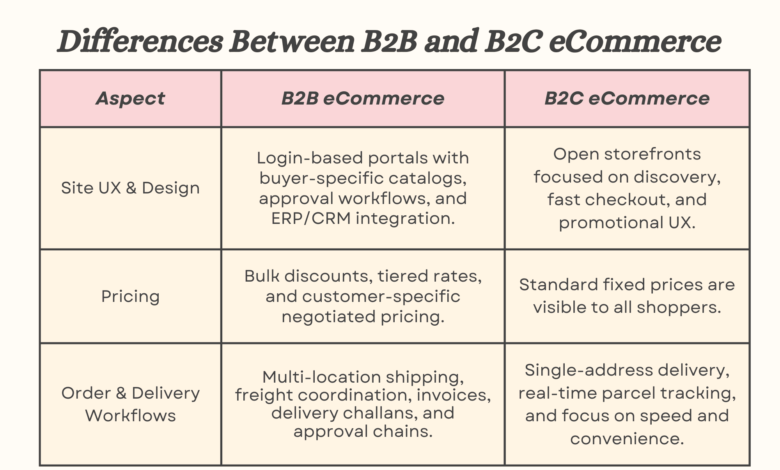
In today’s digital-first marketplace, businesses are increasingly relying on mobile and web applications to drive sales, enhance customer engagement, and streamline operations. Whether you are partnering with an Ecommerce app development company understanding the differences between B2B and B2C eCommerce app development is essential before starting your project. While both models focus on online transactions, their goals, users, features, and technical requirements differ significantly. This article explores the key development differences between B2B and B2C eCommerce apps to help business owners and beginners make informed decisions.
Understanding B2B and B2C eCommerce
Before diving into development differences, it’s important to understand what B2B and B2C mean in the context of eCommerce.
What Is B2B eCommerce?
B2B (Business-to-Business) eCommerce involves transactions between two businesses. Examples include wholesalers selling to retailers, manufacturers supplying distributors, or SaaS companies offering subscription services to enterprises.
B2B eCommerce apps are designed to support bulk ordering, contract-based pricing, and long-term relationships. The buying process is often complex and involves multiple decision-makers.
What Is B2C eCommerce?
B2C (Business-to-Consumer) eCommerce refers to businesses selling products or services directly to individual consumers. Popular examples include online fashion stores, electronics shops, and food delivery platforms.
B2C eCommerce apps focus on user experience, branding, emotional appeal, and fast transactions. The goal is to attract, convert, and retain individual customers.
Why Understanding Development Differences Matters
Choosing the wrong development approach can lead to:
- Poor user experience
- Low customer retention
- Inefficient operations
- Increased maintenance costs
When working with an Ecommerce app development company, understanding whether your business model is B2B or B2C ensures that your app is built with the right features, architecture, and scalability.
Target Audience and User Behavior
B2B User Behavior
B2B users are typically professionals making purchasing decisions for their organizations. Their behavior is driven by:
- Logic and ROI
- Long-term value
- Product specifications
- Supplier reliability
They are less impulsive and more research-oriented. A B2B app must support detailed product data and transparent pricing.
B2C User Behavior
B2C users are individual shoppers who often make emotional and spontaneous decisions. Their behavior is influenced by:
- Design and branding
- Discounts and offers
- Social proof
- Convenience
B2C apps must focus on speed, simplicity, and visual appeal.
Key Development Differences Between B2B and B2C eCommerce Apps
Let’s explore the major areas where B2B and B2C app development differ.
1. User Interface (UI) and User Experience (UX)
B2B UI/UX Design
B2B apps prioritize functionality over aesthetics. The design focuses on:
- Easy navigation
- Advanced filtering
- Detailed dashboards
- Data visualization
Users need quick access to product catalogs, order history, and invoices.
B2C UI/UX Design
B2C apps emphasize visual appeal and emotional engagement. Key elements include:
- Attractive layouts
- High-quality images
- Smooth animations
- Simple checkout flow
A flutter app development company often leverages Flutter’s UI capabilities to create visually rich B2C apps.
2. Registration and User Management
B2B User Management
B2B apps require complex user management systems:
- Multi-level user roles
- Company-based accounts
- Approval workflows
- Access permissions
For example, a company admin may approve purchases made by employees.
B2C User Management
B2C apps focus on simplicity:
- Email or social login
- Guest checkout
- Minimal registration steps
The goal is to reduce friction and increase conversions.
3. Pricing Structure and Payment Models
B2B Pricing
B2B pricing is often customized and flexible:
- Volume-based pricing
- Negotiated contracts
- Customer-specific rates
- Quote-based orders
Your Ecommerce app development company must integrate dynamic pricing systems.
B2C Pricing
B2C pricing is usually fixed and transparent:
- Displayed product prices
- Seasonal discounts
- Coupon codes
- Flash sales
Customers expect clear and immediate pricing information.
4. Order Management System
B2B Order Management
B2B order processing is more complex:
- Bulk orders
- Recurring purchases
- Purchase orders
- Reorder functionality
The system must handle high volumes efficiently.
B2C Order Management
B2C orders are typically smaller and frequent:
- One-click ordering
- Real-time order tracking
- Easy cancellations
- Quick returns
Speed and automation are essential.
5. Product Catalog Management
B2B Catalogs
B2B catalogs are extensive and detailed:
- Technical specifications
- Tiered pricing
- Restricted visibility
- Custom catalogs
Some products may only be visible to certain clients.
B2C Catalogs
B2C catalogs focus on presentation:
- Rich media content
- Reviews and ratings
- Recommendations
- Trending sections
Visual storytelling plays a major role.
6. Search and Navigation Features
B2B Search Capabilities
B2B users often know what they want. Therefore, apps require:
- Advanced filters
- SKU search
- Bulk upload tools
- Saved searches
Efficiency is the top priority.
B2C Search Capabilities
B2C users enjoy exploring. Search features include:
- Auto-suggestions
- Voice search
- Visual search
- Personalized results
AI-driven recommendations are commonly used.
7. Integration With Business Systems
B2B Integrations
B2B apps require deep system integrations:
- ERP systems
- CRM platforms
- Inventory management
- Accounting software
These integrations ensure seamless data flow.
B2C Integrations
B2C integrations are more marketing-focused:
- Payment gateways
- Social media platforms
- Analytics tools
- Customer support systems
A flutter app development company can simplify cross-platform integration.
8. Security and Compliance Requirements
B2B Security
B2B apps deal with sensitive business data and large transactions. Security features include:
- Multi-factor authentication
- Role-based access
- Encrypted data storage
- Compliance standards
High-level security is mandatory.
B2C Security
B2C security focuses on protecting personal data:
- Secure payment processing
- Privacy compliance
- Fraud detection
- Data encryption
User trust is critical.
9. Marketing and Personalization Features
B2B Marketing Tools
B2B marketing is relationship-driven:
- Personalized dashboards
- Targeted offers
- Account-based marketing
- Email automation
The focus is on retention and loyalty.
B2C Marketing Tools
B2C marketing is promotion-driven:
- Push notifications
- In-app ads
- Loyalty programs
- Referral systems
These features encourage repeat purchases.
10. Scalability and Performance
B2B Scalability
B2B platforms must handle:
- Large datasets
- Multiple organizations
- High-volume transactions
- Complex workflows
Scalability is essential for long-term growth.
B2C Scalability
B2C apps must manage:
- Traffic spikes
- Seasonal sales
- Viral campaigns
- High user activity
Performance optimization is critical.
Technology Stack Considerations
Choosing the right technology stack is crucial for both models.
For B2B Apps
- Robust backend frameworks
- Enterprise-grade databases
- API-based architecture
- Cloud infrastructure
These ensure reliability and flexibility.
For B2C Apps
- Cross-platform frameworks
- UI-centric libraries
- Real-time analytics
- Content delivery networks
Many businesses collaborate with a flutter app development company to reduce development time.
Development Cost and Timeline Differences
B2B Development Costs
B2B apps are generally more expensive due to:
- Complex workflows
- Advanced integrations
- Custom features
- Enterprise security
Development timelines are longer.
B2C Development Costs
B2C apps are usually faster to build:
- Standard features
- Reusable components
- Pre-built plugins
However, design and marketing features may increase costs.
Maintenance and Support Requirements
B2B App Maintenance
B2B platforms require:
- Regular system updates
- Performance optimization
- Integration upgrades
- Technical support
Ongoing maintenance is critical.
B2C App Maintenance
B2C maintenance focuses on:
- UI improvements
- Feature updates
- Bug fixes
- User feedback implementation
Customer satisfaction drives updates.
Choosing the Right Development Partner
Selecting the right development partner or pitch deck services can determine your project’s success. A reliable Ecommerce app development company will:
- Understand your business model
- Offer scalable solutions
- Provide post-launch support
- Ensure security compliance
Similarly, a flutter app development company can help you achieve faster development and cross-platform compatibility.
Future Trends in B2B and B2C eCommerce App Development
Both B2B and B2C platforms are evolving rapidly. Key trends include:
- Artificial Intelligence and machine learning
- Voice commerce
- Blockchain payments
- Augmented reality
- Headless commerce
Staying updated with these trends helps businesses remain competitive.
B2B vs. B2C eCommerce Apps: A Quick Comparison
| Feature | B2B eCommerce Apps | B2C eCommerce Apps |
| Target Users | Businesses | Individual consumers |
| Pricing | Customized | Fixed |
| UI Focus | Functionality | Visual appeal |
| Orders | Bulk and recurring | Small and frequent |
| Integrations | ERP, CRM | Marketing tools |
| Security | Enterprise-grade | Consumer-focused |
Final Thoughts
Understanding the key development differences between B2B and B2C eCommerce apps is essential for building a successful digital platform. While B2B apps focus on efficiency, customization, and long-term relationships, B2C apps prioritize user experience, branding, and emotional engagement.
Working with an experienced Ecommerce app development company ensures that your app aligns with your business goals and customer expectations. Likewise, partnering with a skilled flutter app development company can help you create scalable, high-performance applications for multiple platforms.
By clearly defining your business model and development requirements, you can invest wisely, enhance customer satisfaction, and drive sustainable growth in the competitive eCommerce landscape.